Bobby Fischer
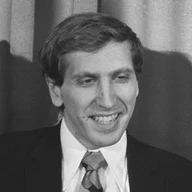
▶ Videos about Bobby Fischer on ChessTube (41)
Beginnings
Born in Chicago on 9 March 1943, to Regina Wender Fischer. He grew up in Brooklyn with his mother and his older sister, Joan.
He learned to play in March 1949, aged six, and nobody taught him: the set was bought by Joan at a candy store, and the two children worked out the moves from the instruction leaflet. Joan soon lost interest and their mother had no time, so he began playing against himself.
Family, date and how he learned: Bobby Fischer, English Wikipedia.The boy from Brooklyn
In January 1951 Carmine Nigro saw him play and took him to the Brooklyn Chess Club: his first teacher. In the summer of 1955 he joined the Manhattan Chess Club, and from June 1956 he went to Jack Collins's Hawthorne Chess Club, which became his home ground.
1956 is the year it became clear who he was. In July he won the US Junior Championship: thirteen years old, the youngest ever to do it. In October, at the Rosenwald tournament, he played a game against Donald Byrne in which he sacrificed his queen for an unstoppable attack. Hans Kmoch called it «the game of the century», and the name stuck. He was thirteen.
Nigro, the clubs, the junior championship and the Byrne game: Bobby Fischer, English Wikipedia.1957: United States champion at fourteen
He won the 1957/58 US championship with 10½ out of 13. He was fourteen years and two months old: the youngest United States champion ever, and still is.
1963/64: eleven out of eleven
At the 1963/64 US championship he won all eleven games. Nobody else, in the history of that tournament, has ever scored a perfect result.
Scores of both championships: Bobby Fischer, English Wikipedia.1971: the Candidates
To reach the world championship he had to win three matches. He beat Mark Taimanov 6–0. He beat Bent Larsen 6–0. Twelve games against two of the strongest players alive, twelve wins, not a single draw. Then he got past Tigran Petrosian, a former world champion, 6½–2½.
Results of the Candidates matches: Bobby Fischer, English Wikipedia.1972: Reykjavík
The match with Boris Spassky was played in Reykjavík and became the most closely followed chess match of the century. Fischer arrived late, disputed the conditions and forfeited the second game by not showing up. His error in the first game of the match is famous: 29...Bxh2, which cost him the game. Then he won the match and the title. The prize fund had been doubled to 250,000 dollars to persuade him to play.
In July of that year his rating reached 2785: one hundred and twenty-five points above the world number two, who at that moment was a certain Boris Spassky. It is the widest gap ever recorded at the top of the list.
Course of the match, the forfeited second game, prize fund and rating: Bobby Fischer, English Wikipedia.The silence, and the return of 1992
He never defended the title. In 1975 no agreement was reached with FIDE over the match conditions and the title passed to Anatoly Karpov without a game being played. Fischer disappeared from chess for twenty years.
He came back in 1992 for a rematch with Spassky, played in Yugoslavia while a UN embargo was in force. He won, and the United States government issued a warrant for his arrest. From then on he lived abroad; arrested in Japan in 2004 over a revoked passport, he was granted Icelandic citizenship by a special act of parliament. He died in Reykjavík on 17 January 2008.
He was sixty-four. Sixty-four, like the squares of a chessboard.
Those years also included public statements of his that were condemned almost everywhere.
1975, the 1992 match, the arrest warrant, Icelandic citizenship and his death: Bobby Fischer, English Wikipedia.gm_W2bF17fFPnAn: scacchiera giocabile, con la partita completa sotto.
gm_PLTDmMabq9rN: scacchiera giocabile, con la partita completa sotto.
gm_GNR_9OVKL8OF: scacchiera giocabile, con la partita completa sotto.
gm_VUflwyVRrjiq: scacchiera giocabile, con la partita completa sotto.
gm_Z7KNu-WT8EfD: scacchiera giocabile, con la partita completa sotto.
gm_CZnVDcS0F2gM: scacchiera giocabile, con la partita completa sotto.
gm_P7yR1PLLysXi: scacchiera giocabile, con la partita completa sotto.
gm_0X-TJiZSSTdj: scacchiera giocabile, con la partita completa sotto.
The book
My 60 Memorable Games, written with Larry Evans and published in 1969, collects sixty of his games annotated by him — including the ones he lost. It is the source of his most quoted sentence: «Tactics flow from a positionally superior game».
Book and co-author: Bobby Fischer, English Wikipedia. Wikiquote attributes the quotation to the book; I could not find a page number, and three slightly different wordings are in circulation.The interzonals, and the US Championship arithmetic
The road to the world title ran through the interzonals, and his three say a lot. At Portorož 1958, aged fifteen, he finished equal fifth on 12 out of 20 and qualified for the Candidates. At Stockholm 1962 he won by two and a half points, 17½ out of 22, without losing anything. At Palma de Mallorca 1970 he won again, 18½ out of 23.
Between 1968 and 1970 there are four results that explain why nobody wanted to meet him: Netanya 1968, 11½ out of 13; Vinkovci 1968, 11 out of 13; Buenos Aires 1970, 15 out of 17; Rovinj-Zagreb 1970, 13 out of 17. The first three he finished without a defeat. Our holdings recompute them all game by game, and they agree.
The United States Championship he entered eight times and won eight times, every time by at least a point. In total 74 points out of 90: sixty-one wins, twenty-six draws and three defeats across twelve years of that event.
He went to the Olympiads four times, between 1960 and 1970, and came back with two individual silvers and a bronze. In our holdings those four editions are 66 games: 41 won, 7 lost, 18 drawn. His encyclopedia entry counts 65 and gives him 49 points: we hold one more, which is why we say the figure is ours.
The placings and scores for Portorož 1958, Stockholm 1962 with its margin, Palma de Mallorca 1970, Netanya 1968, Vinkovci 1968, Buenos Aires 1970 and Rovinj-Zagreb 1970; the eight US Championship wins with the 74 out of 90 total and the one-point minimum margin; the four Olympiads with the three individual medals and the 49 out of 65 total: Bobby Fischer, English Wikipedia. The records of those seven events are recounted on our own holdings and agree with those scores one by one. The 66 Olympiad games are counted on our own holdings: the first version of this count said 88, because "Stockholm Interzonal" ends with the three letters of "olm", the abbreviation archives use for the Olympiads, and the whole 1962 interzonal had been swept in.The games
The archive holds 828 of his games, from 1955 to 1992. Positions appear in the sections of the years they belong to, as the engine analyses them.
Frequently asked questions
Where do Bobby Fischer's positions come from?
From his real games. Every position is a moment in a game Bobby Fischer actually played: above the board you can see both players, the tournament and the year. The best move is identified by Stockfish, analysing the position.
Why is the board covered?
So the solution is not given away to anyone scrolling the page. The first two ranks stay readable and the rest is veiled: the whole position appears when you open the puzzle.
Do I need an account to solve Bobby Fischer's puzzles?
Yes. The puzzle is played on the training page, where the result counts towards that puzzle's leaderboard and moves the player's Elo rating. Without an account there is no rating to update.
Did Bobby Fischer win all these positions?
No. Some come from games he lost, and in those the move to find belongs to his opponent. The box says so next to the board, before you open the puzzle.
What happens after solving or missing one of Bobby Fischer's puzzles?
That puzzle's leaderboard appears, along with two ways on: leave, which brings you back to this page, or keep playing, which offers another position taken from Bobby Fischer's games.
Can you see the whole game after the puzzle?
Yes. Once the puzzle is over, every move of that game appears, and they are clickable: tap one and the position goes onto the board while <b>Stockfish 18</b> analyses it on the spot, in your browser, showing the best lines. You can move back and forth through the whole game.
How many Bobby Fischer positions are there?
At the moment 8. The number grows on its own: a program works through the archive of his games and adds new positions whenever it finds them.
Who wrote the biographical notes?
We wrote them ourselves. The at-a-glance data — dates, places, titles — comes from Wikidata and Wikipedia, under the licence stated below the panel.