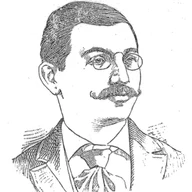
Emanuel Lasker
▶ Videos about Emanuel Lasker on ChessTube (4)
Beginnings
Born on 24 December 1868 in Berlinchen, Prussia — today Barlinek, in Poland. Chess was taught to him by his elder brother Berthold, a strong player himself, who took him along to Berlin. Lasker studied mathematics, and never stopped doing so for the rest of his life.
Date, place and family: Wikidata (Q57095) and the article Emanuel Lasker, English Wikipedia.1889: the double bishop sacrifice
In Amsterdam, in 1889, against Johann Hermann Bauer he played the combination that carries his name. He gave up both bishops to tear open the black king: 15.Bxh7+ Kxh7 16.Qxh5+ Kg8 17.Bxg7 Kxg7 18.Qg4+, and the queen arrives on a king left without defenders. The double bishop sacrifice has been a textbook theme ever since.
In 1893, in New York, he won the tournament with thirteen wins out of thirteen.
The game is in our own archive: Emanuel Lasker – Johann Bauer, Amsterdam 1889. New York 1893: Wikipedia.1894: the world title
In 1894 he faced Wilhelm Steinitz, the first world champion, and beat him: he became the second. Steinitz asked for a rematch and got it in 1896-97; Lasker won again, by a wider margin than the first time.
Article Emanuel Lasker, English Wikipedia.Twenty-seven years as champion
He held the title from 1894 to 1921: twenty-seven years, longer than any other world champion before or since. In 1908 he defended it against Siegbert Tarrasch; in 1914 he won the St Petersburg tournament.
While world champion he took a doctorate in mathematics at Erlangen, in 1902, with a thesis on series at the boundary of convergence. In 1905 he published a paper introducing the primary decomposition of ideals: Emmy Noether would generalise it, and the result is known today as the Lasker-Noether theorem. It is one of the foundations of abstract algebra.
Doctorate, the 1905 paper and the Lasker-Noether theorem: article Emanuel Lasker, English Wikipedia.1921: Capablanca
In Havana, in 1921, he lost the title to José Raúl Capablanca. He did not win a single game: four losses and ten draws, then he abandoned the match. He was fifty-two.
Article Emanuel Lasker, English Wikipedia.New York 1924, Moscow 1935
In 1924, at fifty-five, he won the New York tournament ahead of Capablanca, who was world champion, and ahead of Alexander Alekhine.
In 1935, at sixty-six, he played the Moscow tournament and finished third without losing a game: six wins and thirteen draws, 12½ out of 19. Half a point behind the winners Mikhail Botvinnik and Salo Flohr, and ahead of Capablanca.
Final standings of Moscow 1935: article Moscow 1935 chess tournament, English Wikipedia.The last years
In 1933 he left Germany because of Nazi persecution, and lost his property. He lived in England, then from 1935 in Moscow, where he was granted Soviet citizenship and worked at the institute of mathematics. In October 1937 he moved to the United States.
He died in New York on 11 January 1941, of a kidney infection.
Emigration, the Soviet years and his death: article Emanuel Lasker, English Wikipedia; dates confirmed on Wikidata (Q57095).gm_AR9TjIOxX7kO: scacchiera giocabile, con la partita completa sotto.
gm_tC1l8-53nzvX: scacchiera giocabile, con la partita completa sotto.
gm_Sii68TnclXPl: scacchiera giocabile, con la partita completa sotto.
gm_sIJ3FmOg2Ulo: scacchiera giocabile, con la partita completa sotto.
gm_wQuOZ6zXw6OJ: scacchiera giocabile, con la partita completa sotto.
gm_OmsdkojavWdV: scacchiera giocabile, con la partita completa sotto.
gm_3KiqeG0RCoQZ: scacchiera giocabile, con la partita completa sotto.
How his contemporaries saw him
José Raúl Capablanca, who took the title from him, wrote that no player surpassed Lasker in the ability to assess a position quickly and accurately, and described him as a tenacious defender and as someone who finished off his own attacks efficiently. He also observed that Lasker played in no definite style.
Richard Réti argued that Lasker deliberately played inferior moves, chosen to make the position uncomfortable for his opponent.
Bobby Fischer, in 1964, left him out of his list of the ten greatest in history and called him “a coffee-house player who knew nothing about openings and didn’t understand positional chess”. He revised that judgement later.
Assessments by Capablanca, Réti and Fischer: article Emanuel Lasker, English Wikipedia, which gives the sources.Four first prizes in a row
The event that made his name in Europe was Hastings 1895, and he did not win it: he came third, behind Harry Nelson Pillsbury and Mikhail Chigorin. He had been world champion for a year, and he finished ahead of Tarrasch and of Steinitz, the man he had taken the title from.
From there began a sequence nobody had assembled before: first at St Petersburg 1895-96, a four-man event among the strongest players alive, ahead of Steinitz, Pillsbury and Chigorin; first at Nuremberg 1896; first at London 1899; first at Paris 1900. In our holdings London 1899 is 26 encounters with 18 won, one lost and seven drawn, and Paris 1900 sixteen with fourteen won: two of the most emphatic records of their day.
After that the placings vary more: equal second at Cambridge Springs 1904; equal first at the Chigorin Memorial in St Petersburg in 1909, where our records give him 14½ out of 18; second at Moscow 1925, a point and a half behind Bogoljubow and half a point ahead of Capablanca.
The part that lands hardest, though, is the last. At sixty-five he was still playing in the top flight: fifth at Zürich 1934, then sixth at Moscow and equal seventh at Nottingham in 1936, aged sixty-seven, in a field that included Capablanca, Botvinnik, Alekhine, Euwe, Fine, Reshevsky and Flohr. His last game in our holdings is from that year. In all we credit him with 25 events of at least nine encounters, 5 of which he finished without a defeat.
The third place at Hastings 1895 with the names of those above and below him, the first prizes at St Petersburg 1895-96 (noted there as an elite four-player event), Nuremberg 1896, London 1899 and Paris 1900, the shared second at Cambridge Springs 1904, the shared first at the 1909 Chigorin Memorial, the second at Moscow 1925 with its margins, the fifth at Zürich 1934, the sixth at Moscow 1936 and the equal seventh at Nottingham 1936: Emanuel Lasker, English Wikipedia. The records for London 1899, Paris 1900 and the Chigorin Memorial, the date of his last game and the count of 5 events out of 25 without a defeat are counted on our own holdings; the criterion is: events of at least nine encounters, excluding matches, simultaneous displays, blitz and rapid.The games
Our archive holds 898 games by Lasker, from 1889 to 1936, against more than four hundred different opponents. The positions below come from those games.
Games from PGN Mentor. The moves of a chess game are a fact, not a copyrighted work.Frequently asked questions
Where do Emanuel Lasker's positions come from?
From his real games. Every position is a moment in a game Emanuel Lasker actually played: above the board you can see both players, the tournament and the year. The best move is identified by Stockfish, analysing the position.
Why is the board covered?
So the solution is not given away to anyone scrolling the page. The first two ranks stay readable and the rest is veiled: the whole position appears when you open the puzzle.
Do I need an account to solve Emanuel Lasker's puzzles?
Yes. The puzzle is played on the training page, where the result counts towards that puzzle's leaderboard and moves the player's Elo rating. Without an account there is no rating to update.
Did Emanuel Lasker win all these positions?
No. Some come from games he lost, and in those the move to find belongs to his opponent. The box says so next to the board, before you open the puzzle.
What happens after solving or missing one of Emanuel Lasker's puzzles?
That puzzle's leaderboard appears, along with two ways on: leave, which brings you back to this page, or keep playing, which offers another position taken from Emanuel Lasker's games.
Can you see the whole game after the puzzle?
Yes. Once the puzzle is over, every move of that game appears, and they are clickable: tap one and the position goes onto the board while <b>Stockfish 18</b> analyses it on the spot, in your browser, showing the best lines. You can move back and forth through the whole game.
How many Emanuel Lasker positions are there?
At the moment 7. The number grows on its own: a program works through the archive of his games and adds new positions whenever it finds them.
Who wrote the biographical notes?
We wrote them ourselves. The at-a-glance data — dates, places, titles — comes from Wikidata and Wikipedia, under the licence stated below the panel.