Judit Polgár
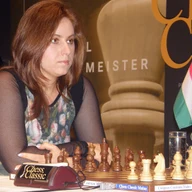
▶ Videos about Judit Polgár on ChessTube (10)
Her father's experiment
Born in Budapest on 23 July 1976, the third of three sisters. Her father, László Polgár, had a thesis to prove: "Geniuses are made, not born." He and his wife Klára educated their three daughters at home, with chess as the specialist subject — and Esperanto alongside it.
When the Hungarian Chess Federation insisted the girls play in women-only tournaments, her father answered in writing: "Women are able to achieve results similar, in fields of intellectual activities, to that of men. Chess is a form of intellectual activity, so this applies to chess. Accordingly, we reject any kind of discrimination in this respect." It was 1986, and Judit was ten.
The oldest game we have of hers is from 1987: she was eleven.
Date and place of birth and the sisters: Wikidata (Q183250) and Judit Polgár, English Wikipedia. Her father's thesis: David Shenk, The Immortal Game, 2006, p. 132, and Eli Shvidler, "All the right moves", Haaretz, 22 November 2007. The words on discrimination: Patricia Koza (UPI), "Sisters test male domination of chess", The Mohave Daily Miner, 9 November 1986, p. B2. 1987 is the date of her oldest game in our archive.International Master at twelve
In 1988, at twelve, she was awarded the title of International Master. For scale: Bobby Fischer and Garry Kasparov had it at fourteen.
In January 1989, aged twelve, she was the top-rated woman in the world. She would stay there, without a break, for more than a quarter of a century.
The title at twelve and the comparison with Fischer and Kasparov: The Spokesman-Review, "Girl stuns chess world", 2 November 1988, and Nashua Sunday Telegraph, 30 October 1988, cited in Judit Polgár, English Wikipedia. Top-rated woman from January 1989: FIDE rating lists, OlimpBase.1991: Grandmaster at fifteen
In 1991 she became a Grandmaster by winning the Hungarian National Championship. She was fifteen years and four months old: she beat by one month the record of Bobby Fischer, which had stood for thirty-three years. She was the fourth woman in history to earn the full title — and she took it the same year her sister Susan became the third.
Title, age, the Hungarian championship and Fischer's record beaten by a month: The Globe and Mail, "Hungarian teen-ager achieves rank of chess grandmaster", 5 February 1992, and Judit Polgár, English Wikipedia.The match with Spassky
In 1993, in Budapest, she played a ten-game match against Boris Spassky, world champion from 1969 to 1972. She won it: five and a half to four and a half, with three wins, two losses and five draws.
Score: recounted on the ten games in our archive (event Budapest m), and it agrees with the published one.In the world top ten
In January 1996, with 2675 Elo points, she entered the overall world rating list at number ten. She is the only woman ever to have been ranked among the ten best players in the world.
She never played the Women's World Championship, and almost never women-only tournaments. It was not a polemic: it was the continuation of the choice made at home in 1986.
The tenth place of January 1996 with 2675 points: Jonathan Berry, 6 January 1996, cited in Judit Polgár, English Wikipedia. The absence from women-only tournaments: the same article.2002: she beats Kasparov
On 9 September 2002, in the Russia versus the Rest of the World match, she beat Garry Kasparov with the white pieces. She was the first woman to beat the reigning world number one in a competitive game. Over their whole record Kasparov remains well ahead — twenty-eight games, five and a half to twenty-two and a half — but that game is that game.
In January 2004 she reached her highest overall ranking: number 8 in the world.
Date, event and colour of the game: recounted on our archive. That she was the first woman to beat the reigning number one, and the number 8 of January 2004: Judit Polgár, English Wikipedia. The record against Kasparov is counted on the twenty-eight games in our archive.San Luis 2005
In 2005 she was at San Luis, in Argentina, among the eight of the FIDE World Championship: the only woman ever to have played the final stage of an overall world championship. She finished last.
In July 2005 she reached her highest Elo, 2735. She is the only woman ever to have passed 2700.
San Luis 2005 and the distinction of being the only woman in the final stage, peak Elo 2735 in July 2005: Judit Polgár, English Wikipedia, and FIDE records.The retirement
On 13 August 2014 she announced her retirement from competitive chess. The Times gave her a headline: "Queen who exposed the arrogance of kings." Her last rated game is from September 2014.
She had been the world's top-rated woman since January 1989, without interruption, and stayed first until the list of March 2015: twenty-six years. She was then overtaken by the Chinese player Hou Yifan.
Date of the announcement and the headline: Oliver Moody, "Queen who exposed the arrogance of kings", The Times, 13 August 2014. Last rated game, the twenty-six years at number one and Hou Yifan's overtaking: Judit Polgár, English Wikipedia.gm_hCFMyiylf9kF: scacchiera giocabile, con la partita completa sotto.
gm_DoKuRFt8NZt3: scacchiera giocabile, con la partita completa sotto.
gm_3_qQDYiWsa5v: scacchiera giocabile, con la partita completa sotto.
gm_aGaLDmsfUrJ8: scacchiera giocabile, con la partita completa sotto.
gm_Ja2KcF82BIXA: scacchiera giocabile, con la partita completa sotto.
gm_yUtwdcVk0M0J: scacchiera giocabile, con la partita completa sotto.
gm_VTuqg0Cj9D1Y: scacchiera giocabile, con la partita completa sotto.
How others describe her
The New York Times, in 2001, gave her a headline that says a good deal about the period: "To Men, Losing to Judit Polgár Is No Disgrace."
Of her own, documented, there is a clear position on women in chess: "I always say that women should have the self-confidence that they are as good as male players, but only if they are willing to work and take it seriously as much as male players."
And on the life of a professional chess player: "You have to be very selfish sometimes. If you are in a tournament, you have to think of yourself — you can't think of your wife or children — only about yourself." In 2002, asked whether she still wanted to become world champion, she answered: "Chess is my profession and of course I hope to improve. But I'm not going to give up everything to become world champion; I have my life."
A figure says the rest. In our archive she has beaten at least once ten world champions: Karpov, Kasparov, Kramnik, Anand, Spassky, Topalov, Carlsen, Ponomariov, Kasimdzhanov and Khalifman. With Karpov she played sixty-two games over eighteen years, from 1992 to 2010, finishing at twenty-seven and a half to thirty-four and a half.
The New York Times headline and the line on the profession: David Burgess, "To Men, Losing to Judit Polgár Is No Disgrace", The New York Times, 31 March 2001. The line on women in chess: Sean Phillips, "A Gender Divide In The Ultimate Sport Of The Mind", NPR, 15 August 2010. The 2002 answer: Serena Allott, "Queen takes all", The Telegraph, 16 January 2002. The ten world champions beaten and the record against Karpov are counted on the games in our archive.Ten Olympiads, and the first at twelve
Her first Olympiad is Thessaloniki 1988, in the women's event, with the Hungarian team. She was twelve, and our holdings record what she did: thirteen games, twelve won and one drawn. Twelve and a half out of thirteen.
Two years later, at Novi Sad 1990, still in the women's event: thirteen games, eight wins, one loss and four halved. Then she stopped. From 1994 onward she played the Olympiads in Hungary's open team, the one commonly called the men's, and there she stayed for eight editions: Moscow 1994, Yerevan 1996, 2000, 2002, 2008, 2010, 2012 and 2014, where she played six games — the last competitive ones our holdings credit to her.
In all, across ten Olympiads, that is 108 games: 54 won, 16 lost and 38 drawn, or 73 points out of 108. The move from the women's event to the open one reads straight off the figures: in the two women's editions the record is twenty wins and one defeat in twenty-six games; in the eight open ones it is thirty-four wins and fifteen defeats in eighty-two.
Of her commitments in the archive, 85 run to nine games or more; in 13 she lost nothing. Among them, besides the 1988 Olympiad, the GMA event of 2003: thirteen games, three wins and ten halved.
Every figure in this section is counted on our own holdings: the ten Olympiads with their years and teams, the 108 games with their record, the scores for Thessaloniki 1988 and Novi Sad 1990, the comparison between the two women's editions and the eight open ones, the six games of 2014 and the count of 13 occasions out of 85 without a defeat, with the criterion: occasions of at least nine games, excluding matches, simultaneous displays, blitz and rapid. The event labels in the tournament files distinguish the women's editions from the open ones, and the split is made on those labels. Her retirement from competition is described further up, with its sources.The games
Our archive holds 1825 games of Judit Polgár's, from 1987 to 2014, against more than five hundred different opponents. The most frequent are Karpov (62 games), Anand (58), Topalov (48), Kramnik (46) and Gelfand (40). The positions below come from these games.
Games from PGN Mentor. Games, years and records are counted on our own archive. The opponents are "more than five hundred" and not an exact number: in modern tournament files the same player appears with a full first name in one period and with just the initial in another (Viswanathan Anand up to 1999, V Anand from 2000), so the distinct spellings are 642 but the people between 568 and 642. The per-opponent counts above merge the spellings of the same player; the three Polgár sisters, who share a surname, are instead counted separately. The moves of a game are a fact, not a protected work.Frequently asked questions
Where do Judit Polgár's positions come from?
From his real games. Every position is a moment in a game Judit Polgár actually played: above the board you can see both players, the tournament and the year. The best move is identified by Stockfish, analysing the position.
Why is the board covered?
So the solution is not given away to anyone scrolling the page. The first two ranks stay readable and the rest is veiled: the whole position appears when you open the puzzle.
Do I need an account to solve Judit Polgár's puzzles?
Yes. The puzzle is played on the training page, where the result counts towards that puzzle's leaderboard and moves the player's Elo rating. Without an account there is no rating to update.
Did Judit Polgár win all these positions?
No. Some come from games he lost, and in those the move to find belongs to his opponent. The box says so next to the board, before you open the puzzle.
What happens after solving or missing one of Judit Polgár's puzzles?
That puzzle's leaderboard appears, along with two ways on: leave, which brings you back to this page, or keep playing, which offers another position taken from Judit Polgár's games.
Can you see the whole game after the puzzle?
Yes. Once the puzzle is over, every move of that game appears, and they are clickable: tap one and the position goes onto the board while <b>Stockfish 18</b> analyses it on the spot, in your browser, showing the best lines. You can move back and forth through the whole game.
How many Judit Polgár positions are there?
At the moment 7. The number grows on its own: a program works through the archive of his games and adds new positions whenever it finds them.
Who wrote the biographical notes?
We wrote them ourselves. The at-a-glance data — dates, places, titles — comes from Wikidata and Wikipedia, under the licence stated below the panel.