Maia Chiburdanidze
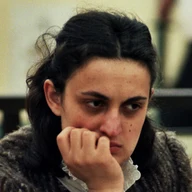
Origins
Born in Kutaisi, Georgia, on 17 January 1961. She learned to play at about eight. At thirteen she won a women's international tournament at Braşov, in 1974, and the following year the one in Tbilisi. In 1976 she was USSR girls' champion.
The oldest game we have of hers is from 1973: she was twelve.
Date, place, the start at eight and the Braşov and Tbilisi tournaments: Maia Chiburdanidze, English Wikipedia; dates confirmed on Wikidata (Q232720). 1973 is the date of her oldest game in our archive.1978: the title at seventeen
In 1977 she won the Soviet women's championship and was awarded the Woman Grandmaster title. In 1978, at Pitsunda, she challenged the reigning world champion — Nona Gaprindashvili, who had held the title for sixteen years — and won it: eight and a half to six and a half. She was seventeen.
The Soviet championship and the 1977 title: Maia Chiburdanidze, English Wikipedia. The score of the match is recounted on the fifteen games in our archive, and it agrees with the published one.The four defences
She defended the title four times, and two of those matches were no stroll. In 1981, at Borjomi and Tbilisi, against Nana Alexandria it finished eight to eight: a tie is enough for the holder, and she kept it. In 1984, at Volgograd, she beat Irina Levitina eight and a half to five and a half. In 1986, at Sofia, she beat Elena Akhmilovskaya by the same score. In 1988, at Telavi, against Nana Ioseliani she closed it eight and a half to seven and a half: half a game.
In 1984 FIDE awarded her the full Grandmaster title. She is the second woman to receive it, after Gaprindashvili.
Venues, years and opponents of the four defences, and the 1984 Grandmaster title: Maia Chiburdanidze, English Wikipedia. The scores of 1981 (8–8), 1986 (8½–5½) and 1988 (8½–7½) are recounted on the games in our archive and agree. For the 1984 match with Levitina we give the published score and not ours: we hold thirteen of its fourteen games.1991: the title to Xie Jun
In February 1991, at Manila, she lost the title to China's Xie Jun: six and a half to eight and a half. She had been world champion for thirteen years — the third longest reign in the history of the women's title, after Vera Menchik's and Gaprindashvili's.
Xie Jun is the opponent she met most often in her career: twenty-nine games, and the overall record is hers, fifteen and a half to thirteen and a half.
Venue, date, score and the length of the reign: Maia Chiburdanidze, English Wikipedia. The match score and the overall record against Xie Jun are recounted on the games in our archive: the match agrees with the published score.Among the men
She played in open tournaments, and she won them. In 1984 she was first at New Delhi; in 1985 first at Banja Luka; in 1987 third at Bilbao. Across those three tournaments, in our archive, she played thirty-two games without losing a single one.
In 1986 she played an eight-game match against grandmaster Petar Popović and it ended four to four. In 1992 she was first at Belgrade, in 1993 at Vienna, and between 1995 and 1997 she won the Lippstadt tournament three times.
In our archive, of her 1341 games, 748 are in tournaments that are not women's events.
New Delhi 1984, Banja Luka 1985, Bilbao 1987, Belgrade 1992, Vienna 1993 and the three Lippstadt wins: Maia Chiburdanidze, English Wikipedia. The thirty-two games without a loss, the score of the Popović match and the count of 748 are counted on the games in our archive. Of Vienna 1993 our archive holds no games: that first place comes from the source.After the title
She did not retire. In 1994 she came first in the Tilburg Candidates tournament, but lost the playoff to Zsuzsa Polgar one and a half to five and a half. In 2001 and 2004 she reached the world championship semi-finals, eliminated first by Zhu Chen and then by Antoaneta Stefanova.
Tilburg 1994, the playoff and the two semi-finals of 2001 and 2004: Maia Chiburdanidze, English Wikipedia. The playoff score is the published one and not ours: our archive holds only three of their games from that year, and from two different events.The last years
Her highest Elo rating, 2560, she had reached in January 1988, when she was number 48 in the world. But her most remarkable team result came much later: at the 2008 Dresden Olympiad she won individual gold on board one for Georgia, with a 2715 performance. In all she has nine Olympiad golds between the Soviet Union and Georgia.
Her last competitive game is from July 2012. In 2014 she entered the World Chess Hall of Fame. In 2021 the documentary Glory to the Queen was dedicated to her.
Peak Elo and world ranking, Dresden 2008 with the 2715 performance, the nine golds, the last game of July 2012, the Hall of Fame and the documentary: Maia Chiburdanidze, English Wikipedia.gm_lndv2fc_XzmJ: scacchiera giocabile, con la partita completa sotto.
gm_ROydxzmCV1Eq: scacchiera giocabile, con la partita completa sotto.
gm_vRI9LvWxhGpM: scacchiera giocabile, con la partita completa sotto.
gm_lMZozpGDKSdC: scacchiera giocabile, con la partita completa sotto.
gm_qyS16l4vJKiH: scacchiera giocabile, con la partita completa sotto.
gm_aPrlNeXCoz7o: scacchiera giocabile, con la partita completa sotto.
gm_vxmEUWIOpkj5: scacchiera giocabile, con la partita completa sotto.
How others describe her
Of Chiburdanidze we have found no verbatim quotations with a certain source: she has no Wikiquote entry. There is, however, a reported position of hers: she is unimpressed by "women's chess" as a category, and hopes for a time when there will be no need to distinguish between men's and women's tournaments.
For the rest, the figures. Against Nona Gaprindashvili, twenty years her senior and champion when she was a child, the record is fifteen to nine over twenty-four games. Against Xie Jun, who took her title, it is fifteen and a half to thirteen and a half over twenty-nine games. Against Zsuzsa Polgar, the eldest of the three Hungarian sisters, no: four and a half to ten and a half over fifteen games.
The position on "women's chess": Maia Chiburdanidze, English Wikipedia, which reports it indirectly — which is why we give it as a position and not as a quotation in quotation marks. The absence of verbatim quotations: checked on Wikiquote, where no entry under her name exists. The three records are counted on the games in our archive. The one against Zsuzsa Polgar counts only the fifteen games written under her full name: the archive also holds one game of Sofia Polgar and one of Z Polgar from 2004, and adding them would mean adding different people. With Judit Polgár, the youngest sister, our archive holds no games.Fifteen Olympiads, five defeats
Her most impressive run is not in a single tournament but across thirty years of national team play. Our holdings contain 151 of her Olympiad games, in fifteen editions between 1978 and 2008: 80 won, 66 drawn and 5 lost. A hundred and thirteen points out of a hundred and fifty-one.
Five defeats across fifteen Olympiads means that in ten of those fifteen she lost nothing at all. The ten are Buenos Aires 1978, Malta 1980, Lucerne 1982, Thessaloniki 1984, Dubai 1986, Manila 1992 — where she made ten wins and three halved out of thirteen games — Yerevan 1996, Elista 1998, the 2002 edition and Dresden 2008. The five defeats fall in four editions: one at Novi Sad 1990, one at Moscow 1994, two in 2000 and one in 2004.
Outside the Olympiads, the two knockout events of the world cycle: the 1997 FIDE Candidates, closed on 10 out of 17 with only two defeats, and the 2001 knockout world championship, 10 out of 16. In the Soviet women's championship of 1979, aged eighteen and world champion for a year, she made 11½ out of 17.
Across the whole archive we credit her with 86 occasions of nine games or more, and 22 she carried through without losing: one in four.
Every figure in this section is counted on our own holdings: the 151 Olympiad games with their record, the fifteen editions, the ten closed without a defeat and the four in which the five defeats fall, Manila 1992, the 1997 Candidates, the 2001 knockout world championship, the Soviet women's championship of 1979 and the count of 22 occasions out of 86, with the criterion: occasions of at least nine games, excluding matches, simultaneous displays, blitz and rapid. A note on the data: among the Olympiad rows in our archive there is exactly one labelled as the men's event, Malta 1980, and in all likelihood it is an error in the source file; we have left it in the count and declare it here. Her Olympiad golds and the individual gold at Dresden 2008 are described further up, with their sources.The games
Our archive holds 1341 games of Chiburdanidze's, from 1973 to 2019, against more than six hundred different opponents. The most recurrent are with Xie Jun (29 games), Nana Ioseliani (26), Gaprindashvili (24), Elena Akhmilovskaya (18) and Irina Levitina (18). The positions below come from these games.
Games from PGN Mentor. Games, years and records are counted on our own archive. The opponents are "more than six hundred" and not an exact number: in tournament files the same player sometimes appears with a full first name and sometimes with just the initial, so the distinct spellings are 655 but the people between 616 and 655. The moves of a game are a fact, not a protected work.Frequently asked questions
Where do Maia Chiburdanidze's positions come from?
From his real games. Every position is a moment in a game Maia Chiburdanidze actually played: above the board you can see both players, the tournament and the year. The best move is identified by Stockfish, analysing the position.
Why is the board covered?
So the solution is not given away to anyone scrolling the page. The first two ranks stay readable and the rest is veiled: the whole position appears when you open the puzzle.
Do I need an account to solve Maia Chiburdanidze's puzzles?
Yes. The puzzle is played on the training page, where the result counts towards that puzzle's leaderboard and moves the player's Elo rating. Without an account there is no rating to update.
Did Maia Chiburdanidze win all these positions?
No. Some come from games he lost, and in those the move to find belongs to his opponent. The box says so next to the board, before you open the puzzle.
What happens after solving or missing one of Maia Chiburdanidze's puzzles?
That puzzle's leaderboard appears, along with two ways on: leave, which brings you back to this page, or keep playing, which offers another position taken from Maia Chiburdanidze's games.
Can you see the whole game after the puzzle?
Yes. Once the puzzle is over, every move of that game appears, and they are clickable: tap one and the position goes onto the board while <b>Stockfish 18</b> analyses it on the spot, in your browser, showing the best lines. You can move back and forth through the whole game.
How many Maia Chiburdanidze positions are there?
At the moment 7. The number grows on its own: a program works through the archive of his games and adds new positions whenever it finds them.
Who wrote the biographical notes?
We wrote them ourselves. The at-a-glance data — dates, places, titles — comes from Wikidata and Wikipedia, under the licence stated below the panel.