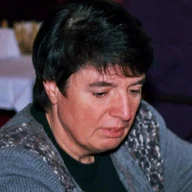
Nona Gaprindashvili
Origins
Born in Zugdidi, Georgia, on 3 May 1941, the youngest of six children and the only girl. Hers was a sporting family and the neighbourhood children would gather at their house to play: in football, she was put in goal. She learned chess from her father at five, and in 1954 moved to Tbilisi to train with the masters.
The oldest game we have of hers is from 1959: she was eighteen.
Date, place, the family, the goalkeeping, her father and the move to Tbilisi: Nona Gaprindashvili, English Wikipedia, which for these details cites Jennifer Shahade, Chess Queens, 2022, ch. 3; dates confirmed on Wikidata (Q231630). 1959 is the date of her oldest game in our archive.1962: the world title
In 1962, at twenty-one, she challenged the world champion Elisaveta Bykova and overwhelmed her: nine to two. In eleven games she did not lose once — seven wins and four draws.
Score: recounted on the eleven games in our archive, and it agrees with the published one.Among the men
This is the part that matters, and the part that was told wrongly for sixty years. Gaprindashvili played in open tournaments, against men, from the start: in 1963/64 she won the Hastings Challengers section. In 1977 she tied for first at Lone Pine, in California — and in those nine games she beat James Tarjan and Anatoly Lein, both grandmasters. In 1978 she tied for second at Dortmund, where she drew with grandmaster Aivars Gipslis.
In our archive, of her 1256 games, 719 are in tournaments that are not women's events: more than half. Across those 719 her record is on the plus side.
Hastings Challengers 1963/64, Lone Pine 1977 and Dortmund 1978: Nona Gaprindashvili, English Wikipedia, which also reports that by 1968 she had already faced at least 59 men, ten of them grandmasters. The scores of those three tournaments, the names of the opponents and the count of 719 games are counted on the games in our archive. The Grandmaster titles of Tarjan, Lein and Gipslis: Wikidata.1978: the title lost, and the first woman Grandmaster
1978 brought her two opposite things. She lost the world title to a seventeen-year-old, Maia Chiburdanidze, after sixteen years of reign: in our archive that match is six and a half to eight and a half. And in the same year FIDE awarded her the Grandmaster title — the full one, not the women's: she is the first woman in history to receive it.
A procedural note that says a good deal: the title normally requires three norms. She had earned one, at Lone Pine. The FIDE congress gave it to her anyway, on the strength of what she had done.
In 1975, shortly before, she had defended the title against Nana Alexandria: eight and a half to three and a half.
The Grandmaster title in 1978, first woman, the Lone Pine norm and the FIDE congress decision: Nona Gaprindashvili, English Wikipedia. The scores of the matches with Chiburdanidze (1978) and Alexandria (1975) are recounted on the games in our archive and agree with the published ones.The Olympiads
She played twelve Olympiads for the Soviet Union, from 1963 to 1990, and in 1992 the first for independent Georgia. She won twenty-five medals: eleven team golds and nine individual golds. At Dubai 1986 she scored ten out of ten.
Olympiads, medals and the perfect score at Dubai 1986: Nona Gaprindashvili, English Wikipedia. Of the Dubai 1986 event our archive holds nine games out of ten, so the ten out of ten comes from the source and not from our own count.The veteran years
She did not stop. She has won the Women's World Senior Championship eight times, and our archive holds games of hers up to 2026: at eighty-five she is still playing. Seventy of her archived games are from the 2020s.
Away from the board she has been a member of the Supreme Soviet of Soviet Georgia and president of the Georgian Olympic Committee. In December 1969 she married Anzor Chichinadze.
The eight senior world titles (as of 2022), the public offices and the marriage: Nona Gaprindashvili, English Wikipedia. The games up to 2026 and the per-decade count are from our archive.gm_1lBQiewkBnCJ: scacchiera giocabile, con la partita completa sotto.
gm_NAbQ8n2FdCXL: scacchiera giocabile, con la partita completa sotto.
gm__F95di5Fa-DK: scacchiera giocabile, con la partita completa sotto.
gm_vjuj87Bf0_zw: scacchiera giocabile, con la partita completa sotto.
gm_VOmM145sYhBc: scacchiera giocabile, con la partita completa sotto.
gm_GoAp3LkGhDHB: scacchiera giocabile, con la partita completa sotto.
gm_EckuhNPZCa4D: scacchiera giocabile, con la partita completa sotto.
The lawsuit against Netflix
The series The Queen's Gambit describes her as a Russian chess player who had never competed against men. That is two errors in one sentence: she is Georgian, and she had faced at least fifty-nine men by 1968, ten of them grandmasters.
On 16 September 2021 she sued Netflix for five million dollars, for false light, invasion of privacy and defamation. In September 2022 Netflix settled, on undisclosed terms.
On the substance, the figures are those of the section further up: 719 games in non-women's tournaments in our archive alone, and two grandmasters beaten at Lone Pine in 1977.
The line in the series, the filing date, the sum and the counts: Nona Gaprindashvili, English Wikipedia, which cites Matt Stevens, "A Chess Pioneer Sues, Saying She Was Slighted in The Queen's Gambit", The New York Times, 16 September 2021, and the text of the filed complaint (Nona Gaprindashvili v. Netflix, Inc., 20 September 2021). The September 2022 settlement: Variety, 6 September 2022. The figure of 59 men by 1968 is in the complaint itself. The 719 games are counted on our archive.How others describe her
Of Gaprindashvili we have found no quotations with a certain source, neither hers nor other players' about her: she has no Wikiquote entry. We are not going to put into her mouth lines that circulate without an origin. If we find a documented one, we will write it here.
In place of judgements, three records counted on our games. Against Alla Kushnir, the opponent of her three defences, she is twenty-eight to seventeen over forty-five games. Against Nana Alexandria, thirteen to four. Against Maia Chiburdanidze, who took her title and who is twenty years younger, nine to fifteen over twenty-four games.
The absence of quotations: checked on Wikiquote, where no entry under her name exists. The three records are counted on the games in our archive.Two interzonals after fifty, and thirty years of seniors
She had lost the world title in 1978, but the cycle did not let go of her. At Kuala Lumpur, in 1990, aged forty-nine, she played the women's interzonal and closed it on 13½ out of 17: twelve wins, two losses and three halved. The year after, at Subotica, aged fifty, she made 9 out of 13. Twenty-eight and twenty-nine years after her first crown, she was still inside the event that selects the challengers.
Then begins the longest stretch of all, and in our holdings also the best documented: the senior tournaments. The earliest games we have of them are from 1995, the latest from June 2026 — eight encounters at the European over-65 women's championship, played at eighty-five. Between those two dates lie thirty years of calendar.
The best results sit in the middle: 8 out of 9 at the over-65 world championship of 2016, 8½ out of 11 in 2018 and another 8½ out of 11 in 2019, aged seventy-eight. In the Soviet women's championship of 1979, when the world title belonged to Chiburdanidze, she finished on 11½ out of 17.
Our holdings recognise 85 occasions of nine games or more for her, and 13 of those closed with zero defeats — and two of those thirteen are senior world championships, won well past seventy.
All the scores in this section are counted on our own holdings: the Kuala Lumpur 1990 and Subotica 1991 interzonals, the eight encounters of the European over-65 championship of June 2026, the over-65 world championships of 2016, 2018 and 2019, the Soviet women's championship of 1979 and the count of 13 events out of 85 without a defeat, with the criterion: events of at least nine games, excluding matches, simultaneous displays, blitz and rapid. That the 1990 and 1991 interzonals were the selection stage of the women's world cycle follows from the event names in the tournament files. The senior titles she won and her recent activity are described further up, with their sources.The games
Our archive holds 1256 games of Gaprindashvili's, from 1959 to 2026: sixty-seven years, against more than seven hundred different opponents. The most recurrent are with Kushnir (45 games), Chiburdanidze (24), Nana Ioseliani (23) and Nana Alexandria (17). The positions below come from these games.
Games from PGN Mentor. Games, years and records are counted on our own archive. The opponents are "more than seven hundred" and not an exact number: in tournament files the same player sometimes appears with a full first name and sometimes with just the initial, so the distinct spellings are 764 but the people between 725 and 764. The moves of a game are a fact, not a protected work.Frequently asked questions
Where do Nona Gaprindashvili's positions come from?
From his real games. Every position is a moment in a game Nona Gaprindashvili actually played: above the board you can see both players, the tournament and the year. The best move is identified by Stockfish, analysing the position.
Why is the board covered?
So the solution is not given away to anyone scrolling the page. The first two ranks stay readable and the rest is veiled: the whole position appears when you open the puzzle.
Do I need an account to solve Nona Gaprindashvili's puzzles?
Yes. The puzzle is played on the training page, where the result counts towards that puzzle's leaderboard and moves the player's Elo rating. Without an account there is no rating to update.
Did Nona Gaprindashvili win all these positions?
No. Some come from games he lost, and in those the move to find belongs to his opponent. The box says so next to the board, before you open the puzzle.
What happens after solving or missing one of Nona Gaprindashvili's puzzles?
That puzzle's leaderboard appears, along with two ways on: leave, which brings you back to this page, or keep playing, which offers another position taken from Nona Gaprindashvili's games.
Can you see the whole game after the puzzle?
Yes. Once the puzzle is over, every move of that game appears, and they are clickable: tap one and the position goes onto the board while <b>Stockfish 18</b> analyses it on the spot, in your browser, showing the best lines. You can move back and forth through the whole game.
How many Nona Gaprindashvili positions are there?
At the moment 7. The number grows on its own: a program works through the archive of his games and adds new positions whenever it finds them.
Who wrote the biographical notes?
We wrote them ourselves. The at-a-glance data — dates, places, titles — comes from Wikidata and Wikipedia, under the licence stated below the panel.