Paul Keres
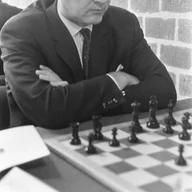
▶ Videos about Paul Keres on ChessTube (1)
Origins
He was born in Narva, Estonia — then part of the Russian Empire — on 7 January 1916. He learned the game from his father and his elder brother Harald. In Estonia chess had to be hunted down: he copied games out of newspapers by hand and built himself a collection of almost a thousand.
Then he found a way to play the world without leaving home: correspondence chess. At secondary school he kept a hundred and fifty games running at once, and in 1935 he won the international IFSB championship.
Meanwhile he won the Estonian schoolboy championship three times — 1930, 1932, 1933 — and in 1935 the Estonian championship itself. That year they sent him to the Warsaw Olympiad on first board, aged nineteen: in our holdings that is nineteen games with eleven wins, five losses and three draws. Two years later, at Prague 1937, he finished 10 out of 11 without losing anything.
Date and place of birth, his father and his brother Harald, the collection of almost a thousand games copied from newspapers, the hundred and fifty simultaneous correspondence games, the 1935 IFSB title, the three schoolboy championships (1930, 1932, 1933), the 1935 Estonian championship and the first board at Warsaw: Paul Keres, English Wikipedia. The records for Warsaw 1935 and Prague 1937 are counted on our own holdings.The war years
Through the German occupation of Estonia he kept playing, and won almost everything. In 1942, at the Estonian championship in Tallinn, he won all fifteen games; at Posen 1943 all five. From those years our holdings contain Madrid 1943 — fourteen games, twelve won, two drawn, none lost — Prague 1943, 14½ out of 19, and Salzburg 1943, five wins and five draws.
He played in four tournaments organised by Ehrhardt Post, the same circuit Alekhine played. And a 1942 newspaper interview was later used by the Germans for anti-Soviet propaganda.
When the Soviet Union reoccupied Estonia in 1944, the bill was presented to him. He avoided deportation, but his return to international competition was postponed, and he was left out of the Soviet team for the 1945 radio match against the United States. These are the facts as the sources report them: we add no verdict.
Tallinn 1942 with fifteen wins from fifteen, Posen 1943, the four tournaments organised by Ehrhardt Post, the 1942 interview used for propaganda, the deportation avoided and the exclusion from the team for the 1945 radio match: Paul Keres, English Wikipedia. Tallinn 1942 and Posen 1943 are not in our holdings and we could not recount them: the records for Madrid, Prague and Salzburg 1943 we could.1948: the tournament for the title
With Alekhine dead as reigning champion, the title was decided by a tournament among the five strongest players. Keres was there. In our holdings that is twenty games with eight wins, seven losses and five draws: 10½ out of 20. Botvinnik won it.
It is the closest he ever came to the title, and the most argued over: much has been written about that tournament, and we stop at the score.
That the 1948 title was decided by a tournament among five players and that Botvinnik won it: World Chess Championship 1948, English Wikipedia. The record of the twenty games is counted on our own holdings (event World Championship 18th).The eternal second
To earn the right to challenge the world champion you had to win the Candidates Tournament. Keres played it four times running and came second four times running.
Zürich 1953: 16 out of 28, equal second. Amsterdam 1956: 10 out of 18, second. 1959, across Bled, Zagreb and Belgrade: 18½ out of 28, second. Curaçao 1962: 17 out of 27, equal second. All four scores, in our holdings, agree exactly with the published ones.
Hence the nicknames: "Paul the Second", "the eternal second", "the crown prince of chess". Not one of the three is a full compliment, and all three say the same thing: he was strong enough to reach the end, and he never reached the top.
The four consecutive second places with their scores and placings, and the three nicknames: Paul Keres, English Wikipedia. The four scores are recounted on our own holdings and agree: 16/28, 10/18, 18½/28 and 17/27. The 1959 one is split across two labels in the tournament files and reassembles when they are added together.Nine world champions
There is a way of measuring Keres that does not run through titles, and our archive allows it: how many world champions he beat. The answer is nine, from Capablanca to Fischer. He is one of only three players in history to have beaten nine undisputed world champions.
Here is the count, game by game, on our own games:
Capablanca 6 games, 3½–2½ · Alekhine 14, 5–9 · Euwe 27, 15½–11½ · Botvinnik 19, 7½–11½ · Smyslov 40, 20–20 · Tal 26, 15–11 · Petrosian 32, 16–16 · Spassky 25, 11½–13½ · Fischer 10, 4½–5½ · Karpov 2, 1–1.
Three things rise out of that line. Against Euwe and against Tal the overall record is his: he finished ahead of two world champions. Against Smyslov and Petrosian it ends exactly level, and Smyslov is the opponent he faced more often than anyone else in his life. And the only one he never beat is Karpov: two games, two draws, in 1973 — Karpov was twenty-two, Keres fifty-seven.
That he beat at least once every champion from Capablanca to Fischer, that his two games with Karpov were drawn, and that he is one of only three players to have beaten nine undisputed champions: Paul Keres, English Wikipedia. Every record in this section is counted on our own holdings, grouping the spellings of each name, and confirms the list of nine on its own.The tournaments: three Soviet titles, eleven Olympiads
The Soviet Championship was then the hardest tournament in the world, harder than almost any international meeting. Keres won it three times: in 1947 at Leningrad with 14 out of 19, in 1950 at Moscow with 11½ out of 17, and in 1951 with 12 out of 17. All three scores, in our holdings, agree to the half point. Of those editions we hold thirteen in all, from 1940 to 1973: thirty-three years at the same tournament.
But his most impressive run is at the Olympiads, and here the figures belong to another category. He played eleven: four for Estonia between 1935 and 1939, then seven consecutive ones for the Soviet Union between 1952 and 1964 — seven team golds out of seven, plus five individual board golds and a bronze.
In our holdings those eleven editions are 150 games, and the record is this: 92 won, 45 drawn and 13 lost. A hundred and fourteen and a half points out of a hundred and fifty, that is 76 per cent, with thirteen defeats across thirty years of Olympiads.
One last figure shows up only if you count: of the 81 engagements of at least nine games our records credit him with, 26 ended without a single defeat. One in three.
The three Soviet Championships with years, venues and scores, and the eleven Olympiads with the countries and all the team and individual medals: Paul Keres, English Wikipedia. The three Soviet scores are recounted on our own holdings and agree; the 150 Olympiad games with their record, the thirteen editions of the Soviet Championship we hold, and the count of 26 engagements out of 81 without a defeat are counted on our own holdings, with the criterion: engagements of at least nine games, excluding matches, simultaneous displays, blitz and rapid.How they describe him
Of his own words, with a certain source, we have what he wrote in his books. From the introduction to Practical Chess Endings: "it is difficult to overestimate the value of good endgame play and time spent on this department is amply repaid." Of the book's purpose he said it was "to give the reader practical help in endgame technique".
Others describe him in agreement with one another, and the agreement says something. Robert McFadden, in the New York Times, wrote of "elegant manners and an informal but unflappable bearing". Samuel Reshevsky was blunter: Keres "was too mild a person to give his all in order to defeat his opponents." And Egon Varnusz, writing of the early 1950s: "The best player in the world was Paul Keres."
Catchphrases attributed to him do circulate, and the best known — "nobody ever won a chess game by resigning" — we do not quote: it is attributed to Tartakower as well and no primary source exists. If we find one, we will write it here.
The two lines by Keres come from the introduction to Practical Chess Endings, of which we do not have the page number and say so. The three quotations about him — Robert McFadden in the New York Times, Samuel Reshevsky and Egon Varnusz — are reported in the Paul Keres article on English Wikipedia, which names their authors. Keres has no Wikiquote page. On the line about resigning: the attribution is split between him and Tartakower and neither has a contemporary source, so it stays out. All quotations here are in their original English.The end
In 1975, aged fifty-nine, he went to play an open tournament at Vancouver, and won it. Our holdings contain those nine games: six wins, three draws, no defeat. They are among the last we have of him.
He died at Helsinki on 5 June 1975, of a heart attack, on his way home from Vancouver to Estonia.
From 1992 to 2011 his portrait was on the five-kroon Estonian banknote. That does not happen to many chess players.
Date, place and cause of death, the journey home from the Vancouver tournament he had won, and the five-kroon banknote in circulation between 1992 and 2011: Paul Keres, English Wikipedia. The record of the nine Vancouver games is counted on our own holdings. We say "among the last" and not "the last" because in the tournament files those games carry no day or month, and cannot be ordered with certainty against the Tallinn games of the same year.gm_0uh5373tydqF: scacchiera giocabile, con la partita completa sotto.
gm_gGrDqsZPJ9Iz: scacchiera giocabile, con la partita completa sotto.
gm_JrZGEk6H4Sqp: scacchiera giocabile, con la partita completa sotto.
gm_47piJOtzZIla: scacchiera giocabile, con la partita completa sotto.
gm_XNcolbRMolt4: scacchiera giocabile, con la partita completa sotto.
gm_QB1V4KXlSDGi: scacchiera giocabile, con la partita completa sotto.
gm_Ywm-t1c-xgrg: scacchiera giocabile, con la partita completa sotto.
The games
Our archive holds 1571 games by Keres, from 1935 to 1975: forty years, against 522 different opponents. The overall record is 696 wins, 708 draws and 167 defeats — one game lost in every nine and a half, across forty years. The most frequent are Vassily Smyslov (40 games), Efim Geller (34), Tigran Petrosian (32), Max Euwe (27), Mikhail Tal (26) and Gideon Ståhlberg (26). The positions below come from these games.
Games from PGN Mentor. Games, years, opponents and records are counted on our own holdings. The number of opponents is exact rather than approximate because across 522 spellings we found no duplicates of the same name. The moves of a game are a fact, not a protected work.Frequently asked questions
Where do Paul Keres's positions come from?
From his real games. Every position is a moment in a game Paul Keres actually played: above the board you can see both players, the tournament and the year. The best move is identified by Stockfish, analysing the position.
Why is the board covered?
So the solution is not given away to anyone scrolling the page. The first two ranks stay readable and the rest is veiled: the whole position appears when you open the puzzle.
Do I need an account to solve Paul Keres's puzzles?
Yes. The puzzle is played on the training page, where the result counts towards that puzzle's leaderboard and moves the player's Elo rating. Without an account there is no rating to update.
Did Paul Keres win all these positions?
No. Some come from games he lost, and in those the move to find belongs to his opponent. The box says so next to the board, before you open the puzzle.
What happens after solving or missing one of Paul Keres's puzzles?
That puzzle's leaderboard appears, along with two ways on: leave, which brings you back to this page, or keep playing, which offers another position taken from Paul Keres's games.
Can you see the whole game after the puzzle?
Yes. Once the puzzle is over, every move of that game appears, and they are clickable: tap one and the position goes onto the board while <b>Stockfish 18</b> analyses it on the spot, in your browser, showing the best lines. You can move back and forth through the whole game.
How many Paul Keres positions are there?
At the moment 7. The number grows on its own: a program works through the archive of his games and adds new positions whenever it finds them.
Who wrote the biographical notes?
We wrote them ourselves. The at-a-glance data — dates, places, titles — comes from Wikidata and Wikipedia, under the licence stated below the panel.