Paul Morphy
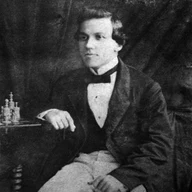
▶ Videos about Paul Morphy on ChessTube (11)
Beginnings
Born in New Orleans on 22 June 1837. He had no teacher: according to his uncle Ernest’s account, he learned by watching others play, and it became clear when he analysed an unfinished game between his uncle and his father and said how it should have ended.
Date, place and how he learned: article Paul Morphy, English Wikipedia; dates confirmed on Wikidata (Q105589).The boy who beat everyone
In 1850, when Morphy was twelve, Johann Löwenthal passed through New Orleans and played him. The sources disagree on the exact score — two losses and a draw, or three losses — but they agree on who lost: Löwenthal.
Article Paul Morphy, English Wikipedia, which reports both versions of the score.1857: the law degree and the first American congress
On 7 April 1857 he graduated in law from the University of Louisiana, today Tulane. He was too young to practise.
From 6 October to 10 November New York hosted the first American chess congress: sixteen players, knockout. Morphy reached the final and beat Louis Paulsen with five wins, one loss and two draws.
Law degree and congress: article Paul Morphy, English Wikipedia.1858: Europe
He sailed for Europe and in a few months beat whoever he found. Löwenthal: nine wins, three losses, two draws. Daniel Harrwitz, in Paris: five, two and one. Then, between 20 and 28 December 1858, Adolf Anderssen, reckoned the strongest in Europe: seven wins, two losses, two draws.
The match with Howard Staunton never happened. Staunton would not travel to New Orleans and insisted Morphy come to Europe; when Morphy did, the match still did not take place. They did sit at the same board, though: at Streatham, in Staunton’s house, they played two consultation games, Staunton and John Owen against Morphy and Thomas Barnes, and Morphy and Barnes won both. One of the two is in our archive, recorded under the names of Staunton and Morphy alone.
In Paris, at the Italian Opera House, he played the Duke of Brunswick and Count Isouard a game that counted for nothing and that everybody knows: it is the Opera Game, and it is in our archive.
Match scores and the Staunton affair: article Paul Morphy, English Wikipedia. The two consultation games at Streatham, the names of the four players and the fact that Morphy and Barnes won both: the records of the two games on chessgames.com and the account in Paul Morphy Goes to England, edochess.ca. The Opera Game and the Staunton game are both in storico.db.The retirement
He returned to America in 1859 meaning to practise law. He stopped playing competitively: from then on he accepted games only at odds. He was twenty-two.
Article Paul Morphy, English Wikipedia.gm_WHOeKWfiQ61I: scacchiera giocabile, con la partita completa sotto.
gm_aQIdh5fKghV3: scacchiera giocabile, con la partita completa sotto.
gm_B9BdUlTmnDVj: scacchiera giocabile, con la partita completa sotto.
gm_ieBXZ52uLrCL: scacchiera giocabile, con la partita completa sotto.
gm_SGfrfp1-EeHQ: scacchiera giocabile, con la partita completa sotto.
gm_07LNW9Womyjz: scacchiera giocabile, con la partita completa sotto.
After chess
The law practice never took off. The family fortune meant he did not have to work, and that is how he spent the rest of his life. In his final years he showed signs of mental illness, including a persecution complex.
He died in New Orleans on 10 July 1884, aged forty-seven. The recorded cause was congestion of the brain, after entering cold water on returning from a long walk in the midday heat.
Later life and cause of death: article Paul Morphy, English Wikipedia.How his contemporaries saw him
Bobby Fischer, in 1964, compiled for Chessworld his list of the ten greatest in history and put Morphy first, writing that he was “perhaps the most accurate player who ever lived” and that in a set match he would beat anybody alive at the time.
Wilhelm Steinitz, in the International Chess Magazine of February 1885, recounted his conversations with Anderssen: in 1862 Anderssen spoke of Morphy “in the highest possible terms”, but by 1866 his enthusiasm “had much cooled down”.
Fischer: The Ten Greatest Masters in History, Chessworld vol. 1 no. 1, January-February 1964, pp. 57-61. Steinitz: International Chess Magazine, February 1885, p. 46, cited in Edward Winter’s pages.One tournament, in a whole lifetime
Of the 211 Morphy games we hold, exactly one real tournament appears: the First American Chess Congress, New York 1857. Everything else is matches, single games, simultaneous displays and consultation games. His competitive career fits into three years.
That congress, in our holdings, is 18 games, and you can see how it worked: a knockout, a mini-match each round. He beat J. Thompson 3-0, Alexander Meek 3-0, Theodor Lichtenhein with three wins and a draw, and the final against Louis Paulsen is the one described further up. Eighteen games across the whole congress, and one single defeat.
The wider picture is of a player who could not find opposition at his level: across the 211 games, 170 won, 23 lost and 18 drawn — 80.6 per cent won. The percentage is inflated by simultaneous displays and by games given at odds, but it remains true that twenty-three defeats in two hundred and eleven games is few for any era.
The games do not stop at his retirement: from 1860 onward we hold 20, between 1862 and 1866, with 17 wins and 3 losses and not one draw. Nearly all were given at odds: they do not count as competition, and that is exactly what makes them say how finished his competitive life was.
That the 1857 congress was a knockout, and the score of the final against Paulsen: Paul Morphy, English Wikipedia. The 18 games of the congress with the four opponents and the score of each round, the 211 games overall with their record and the percentage, and the 20 games from 1860 on are counted on our own holdings. That the congress is his only tournament is said of our holdings, not of his life: two labels in the archive, "Paris it 1858" and "London 1858", gather single games rather than tournaments, and we looked at them one by one before writing this.The games
Our archive holds 211 games by Morphy, from 1848 to 1866. Among his opponents are his uncle Alonzo and his brother Ernest: they played too, and in those games the move to find may be theirs.
Games from PGN Mentor. The moves of a chess game are a fact, not a copyrighted work.Frequently asked questions
Where do Paul Morphy's positions come from?
From his real games. Every position is a moment in a game Paul Morphy actually played: above the board you can see both players, the tournament and the year. The best move is identified by Stockfish, analysing the position.
Why is the board covered?
So the solution is not given away to anyone scrolling the page. The first two ranks stay readable and the rest is veiled: the whole position appears when you open the puzzle.
Do I need an account to solve Paul Morphy's puzzles?
Yes. The puzzle is played on the training page, where the result counts towards that puzzle's leaderboard and moves the player's Elo rating. Without an account there is no rating to update.
Did Paul Morphy win all these positions?
No. Some come from games he lost, and in those the move to find belongs to his opponent. The box says so next to the board, before you open the puzzle.
What happens after solving or missing one of Paul Morphy's puzzles?
That puzzle's leaderboard appears, along with two ways on: leave, which brings you back to this page, or keep playing, which offers another position taken from Paul Morphy's games.
Can you see the whole game after the puzzle?
Yes. Once the puzzle is over, every move of that game appears, and they are clickable: tap one and the position goes onto the board while <b>Stockfish 18</b> analyses it on the spot, in your browser, showing the best lines. You can move back and forth through the whole game.
How many Paul Morphy positions are there?
At the moment 6. The number grows on its own: a program works through the archive of his games and adds new positions whenever it finds them.
Who wrote the biographical notes?
We wrote them ourselves. The at-a-glance data — dates, places, titles — comes from Wikidata and Wikipedia, under the licence stated below the panel.