Siegbert Tarrasch
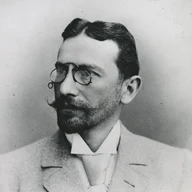
▶ Videos about Siegbert Tarrasch on ChessTube (2)
Origins
Born in Breslau on 5 March 1862, in the Kingdom of Prussia — today Wrocław, in Poland. His parents were Moritz Tarrasch, a merchant, and Philippine Grabower. He attended the city's Jewish primary school and at eight moved to the Elisabet Gymnasium, where he matriculated in 1880.
He studied medicine in Berlin and then at Halle-Wittenberg. The oldest game we have of his is from 1879: he was seventeen.
Date, place, family and studies: Siegbert Tarrasch, German Wikipedia, which cites the memorial book of Munich's Jews (Munich City Archive); dates confirmed on Wikidata (Q76558). 1879 is the date of his oldest game in our archive.The doctor of Nuremberg
He won his first tournament in 1883, in Nuremberg. From 1886 he worked for a year as a general practitioner in Geroldsgrün, in Upper Franconia. On 7 March 1887 he took his doctorate in medicine at the University of Leipzig, with a thesis on subacute and chronic anterior poliomyelitis; his supervisor was Paul Flechsig.
That same year he settled in Nuremberg, where he practised until 1914. All his life chess remained what he did alongside his profession, not instead of it.
First tournament, the year at Geroldsgrün, the date and title of the thesis, his supervisor and the Nuremberg years: Siegbert Tarrasch, German Wikipedia.Four congresses in a row
He won the international tournaments of the German Chess Federation congresses at Breslau 1889, Dresden 1892 and Leipzig 1894, and in 1890 the tournament of Manchester. In the EDO historical ratings he comes out world number one in 1890 and 1891.
In those years he refused twice. The chess club of Havana wanted to organise a world title match between him and Wilhelm Steinitz: he declined for professional reasons. In 1892 he declined a match with Emanuel Lasker, who at the time had no outstanding results yet. In 1894 it was Lasker who took the title from Steinitz.
In 1893, in St Petersburg, he played a match with Mikhail Chigorin and it ended level: nine wins, nine losses and four draws. In 1894 in Nuremberg he beat Carl August Walbrodt seven to nil, with one draw.
The three congresses with their tournament tables, Manchester and the two refusals: Siegbert Tarrasch, German and English Wikipedia. World number one in 1890 and 1891: EDO Historical Chess Ratings. The scores of both matches are recounted on the games in our archive and agree with the published ones.The world champion of tournaments
His highest historical Elo rating, 2824, he reached in June 1895. These were the years of his greatest results: first at the Emperor's Jubilee tournament in Vienna in 1898 and first at Monte Carlo in 1903. In that period people called him the "world champion of tournaments" — because the real title he had never played for.
Against Lasker, meanwhile, it was still open: he beat him at Hastings in 1895 and lost to him at Nuremberg in 1896. In 1905, in Nuremberg, he overwhelmed Frank Marshall: eight wins, one loss and eight draws.
Historical Elo and the first places at Vienna 1898 and Monte Carlo 1903, with the epithet Turnierweltmeister: Siegbert Tarrasch, German Wikipedia. Hastings 1895, Nuremberg 1896 and the score of the Marshall match: recounted on the games in our archive.1908: the match with Lasker
In 1907 he won the champions' tournament of Ostend. The world championship match with Lasker only came about in 1908, after very long negotiations, and was played between Düsseldorf and Munich. By then Tarrasch was past his peak: he lost three to eight, with five draws. The German article writes that he never quite got over it.
Ostend 1907: Siegbert Tarrasch, English Wikipedia. Negotiations, venues, score and his state of mind: the German article, which points to the book Tarrasch himself wrote on the match (Leipzig 1908). All sixteen games are in our archive and the count agrees.The books and the Tarrasch Defence
On 28 May 1909, at forty-seven, he converted from Judaism to Lutheran Protestantism: he wanted, the German article writes, to be recognised as a German without discrimination.
Three openings carry his name: the Tarrasch Defence in the Queen's Gambit, which he invented and championed all his life; the Tarrasch Variation of the French Defence; and the Tarrasch Trap in the Spanish Game, from one of his games against Marco in 1892. Of the defence that bears his name, and of the isolated queen's pawn it produces, he said: "The future will decide who has erred in estimating this defence: I or the chess world." Today it is considered sound, though unfashionable.
In 1911, in Cologne, the match with Carl Schlechter ended level: three to three, with ten draws.
Date of the conversion, the three openings and the 1892 trap: Siegbert Tarrasch, German Wikipedia. The remark about the future and the isolated pawn: the English article. Score of the Schlechter match: recounted on the games in our archive.The war and the sons
At the great St Petersburg 1914 tournament he came fourth, behind Lasker, Capablanca and Alekhine and ahead of Marshall, and won one of the three brilliancy prizes — for the game in which he beat Nimzowitsch, the opponent who accused him of being dogmatic. On 30 September 1914 he moved to Munich.
He had six children, three sons and three daughters; one daughter died young. All three sons died before him. Paul, born in 1892 and greatly gifted at chess, died at twenty on 9 September 1912 in Hamburg: the cause given was "acute cardiac paralysis", but it was a suicide. Fritz, born in 1888, a lieutenant decorated with the Iron Cross, fell on the Western Front on 14 May 1915. Hans Richard, born in 1890, died in an accident in 1916.
In the autumn of 1916, in Berlin, he played a second match with Lasker, not for the title, and lost it more heavily than the world championship one: no wins, five losses and one draw. That same autumn and in the same venue he beat Jacques Mieses: seven to two, with four draws.
St Petersburg 1914, the brilliancy prize, the move to Munich, the six children and the three deaths, and both 1916 matches: Siegbert Tarrasch, German Wikipedia, which for the family cites the memorial book of Munich's Jews. For the 1916 Lasker match we give the published score and not ours: our archive holds four of the six games. The score of the Mieses match is instead recounted on ours, and agrees.The last years
He went on playing major tournaments until 1928, without great results any more. At the London Olympiad of 1927 he played board one for the German team and scored eight and a half points out of fifteen. In 1924 he divorced and remarried, to Gertrude Schröder.
From October 1932 he published a magazine of his own, Tarraschs Schachzeitung. Born a Jew, he managed to carry it on until his death: the National Socialists did not ban it. Whether that was out of the respect owed to the great master or simply because little time had passed since January 1933, is not known: the German article says so, and so do we, because nobody has established it.
He died in Munich on 17 February 1934, at seventy-one, of the consequences of pneumonia. He is buried in Munich's northern cemetery. His grave had been dissolved: in 1996, on the initiative of the chess player Alfred Schattmann and his club, a stone was put back on it, unveiled by the grandmaster Wolfgang Unzicker. On it there is a chessboard bordered by the words Praeceptor Germaniae, and a knight.
Last tournaments, the London Olympiad (olimpbase.org), the divorce, the magazine and why it was not banned (Wolfgang Unzicker in Rochade Europa, February 1999), cause of death, burial and the 1996 stone: Siegbert Tarrasch, German Wikipedia.gm_sctRI-1K1bUT: scacchiera giocabile, con la partita completa sotto.
gm_-NiSpR5udHVy: scacchiera giocabile, con la partita completa sotto.
gm_EgTecwWBYhXr: scacchiera giocabile, con la partita completa sotto.
gm_cXUQu4_udMae: scacchiera giocabile, con la partita completa sotto.
gm_bK_EEkjJO5bK: scacchiera giocabile, con la partita completa sotto.
gm_OiGmHwbsOHUn: scacchiera giocabile, con la partita completa sotto.
gm_BD5KOqbvK0ge: scacchiera giocabile, con la partita completa sotto.
How others describe him
He was called "Praeceptor Germaniae", teacher of Germany, already in his lifetime. Building on Steinitz, he taught how much control of the centre matters. And he was convinced of something that is done here every day: that in almost every position there is a single best move, and that the game consists in finding it.
He wrote it in his last book: "Every position must be regarded as a problem, in which the task is to find the right move, the one the position requires and which almost always is a single one."
Critics said his teaching was too dogmatic. The first was Nimzowitsch, in the Wiener Schachzeitung — the same Nimzowitsch who recognised him as one of those who had opened the way to modern chess. Garry Kasparov, writing about his great predecessors, dismisses the charge: Tarrasch's critics called him dogmatic unfairly.
Of him Rudolf Spielmann, who had played him eighteen times, said: "From Anderssen I learned the art of making combinations; from Tarrasch I learned how advantageously to avoid making them."
And for the line he is best known by, the most his of all, there is the primary source — the preface of his 1931 book: "I have always a slight feeling of pity for the man who has no knowledge of chess, just as I would pity the man who has remained ignorant of love. Chess, like love, like music, has the power to make men happy." In the same work, on the endgame: "Mistrust is the most necessary characteristic of the chess player."
The epithet in his lifetime, the centre and the single move: Siegbert Tarrasch, German Wikipedia, citing Das Schachspiel, 1931, p. 306. The charge of dogmatism: Nimzowitsch in the Wiener Schachzeitung, no. 5, reprinted in My System; Kasparov's reply: On My Great Predecessors, part I, p. 160. Spielmann: Irving Chernev, The Bright Side of Chess, 1952, p. 107; the eighteen games are counted in our archive. The two lines by Tarrasch: Das Schachspiel, 1931 — the first from the preface (the sourced-and-verified section of the German Wikiquote), the second on p. 79 of the English translation The Game of Chess.The German congresses, from seventeen to sixty-three
The longest thread in his career is the German Chess Federation congresses, which for German-speaking players mattered more than any other engagement. Our holdings contain nine editions, and set side by side they tell a whole life.
It starts at Breslau in 1879, with sixteen games played at seventeen years old: thirteen won, three lost and not a single draw. Then the congresses: 1885, 11½ out of 17; 1887, 11 out of 19; 1889, 13 out of 17; 1892, 12 out of 16; 1894, 13½ out of 17. 1889 is the edition he won, and it is also the only time in his whole career that he closed a tournament losing nothing: nine wins and eight draws. Of the 35 engagements of nine games or more we credit him with, that one remains the only.
Then the curve falls, and the congresses measure it better than any account: 1906, 7½ out of 16; 1910, 8 out of 16; 1912, 11 out of 17, the last good one; 1914, 5½ out of 11. The last of all is the twenty-fourth, in 1925, aged sixty-three: 3½ out of 11, with one win and five defeats. That same year, at Baden-Baden, he finished 7½ out of 20.
Between the first game our holdings credit him with, in 1879, and the last, in 1928, lie forty-nine years. Among the champions on these pages only Gaprindashvili, Karpov and Spassky span longer, and all three played in an age when people live longer.
That he won the Breslau congress of 1889 is in the Siegbert Tarrasch article on English Wikipedia, already cited further up. All the scores and records in this section — the nine congress editions, Breslau 1879, Baden-Baden 1925, the only tournament closed without a defeat out of 35 engagements and the span 1879–1928 — are counted on our own holdings, with the criterion: engagements of at least nine games, excluding matches, simultaneous displays, blitz and rapid. The comparison of career spans is made across the pages published here, not across the whole history of chess: the first version of this line said his was the longest, and it was not true — Gaprindashvili runs from 1959 to 2026.The games
Our archive holds 704 games of Tarrasch's, from 1879 to 1928, against 152 different opponents. The most frequent are Schlechter (39 games), Marshall (38), Chigorin (35), Lasker (28) and Mieses (27). Against Lasker, all told, the record is four wins, seventeen losses and seven draws. The positions below come from these games.
Games from PGN Mentor. Games, years, opponents and records are counted on our own archive. The moves of a game are a fact, not a protected work.Frequently asked questions
Where do Siegbert Tarrasch's positions come from?
From his real games. Every position is a moment in a game Siegbert Tarrasch actually played: above the board you can see both players, the tournament and the year. The best move is identified by Stockfish, analysing the position.
Why is the board covered?
So the solution is not given away to anyone scrolling the page. The first two ranks stay readable and the rest is veiled: the whole position appears when you open the puzzle.
Do I need an account to solve Siegbert Tarrasch's puzzles?
Yes. The puzzle is played on the training page, where the result counts towards that puzzle's leaderboard and moves the player's Elo rating. Without an account there is no rating to update.
Did Siegbert Tarrasch win all these positions?
No. Some come from games he lost, and in those the move to find belongs to his opponent. The box says so next to the board, before you open the puzzle.
What happens after solving or missing one of Siegbert Tarrasch's puzzles?
That puzzle's leaderboard appears, along with two ways on: leave, which brings you back to this page, or keep playing, which offers another position taken from Siegbert Tarrasch's games.
Can you see the whole game after the puzzle?
Yes. Once the puzzle is over, every move of that game appears, and they are clickable: tap one and the position goes onto the board while <b>Stockfish 18</b> analyses it on the spot, in your browser, showing the best lines. You can move back and forth through the whole game.
How many Siegbert Tarrasch positions are there?
At the moment 7. The number grows on its own: a program works through the archive of his games and adds new positions whenever it finds them.
Who wrote the biographical notes?
We wrote them ourselves. The at-a-glance data — dates, places, titles — comes from Wikidata and Wikipedia, under the licence stated below the panel.