Vera Menchik
Origins
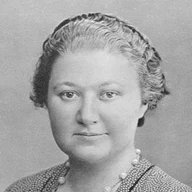
Born Vera Mencikova in Moscow, on 16 February 1906: her mother Olga Illingworth was English, her father František Menčík Czech. She had a younger sister, Olga, born a year later, who also played chess.
In 1921, after the Russian revolution, the family split: she, her mother and her sister moved to England, to Hastings; her father returned to Bohemia.
The oldest game we have of hers is from 1923, at Hastings: she was seventeen.
Birth name, date, place, the parents and the sister: Vera Menchik, English Wikipedia, which for these details cites Robert B. Tanner's biography Vera Menchik: A Biography of the First Women's World Chess Champion, 2016, pp. 9 and 19, and the Hastings Chess Club profile written by Brian Denman. Dates confirmed on Wikidata (Q157867). 1923 is the date of her oldest game in our archive.1927: the first world champion
In 1927 the first Women's World Championship in history was played: a round-robin with twelve players from eight European countries. Menchik won it with ten and a half out of eleven, conceding a single draw, to Edith Michell. She finished a point and a half ahead of the runner-up.
She would hold that title until her death: seventeen years, the longest reign in the history of chess.
Tournament format, score and margin: Vera Menchik, English Wikipedia, citing Tanner 2016, pp. 12 and 222–223, and Jennifer Shahade, Chess Queens, 2022, p. 33.Carlsbad 1929, and the club named after her
In 1929 she played at Carlsbad among the strongest players in the world. She finished last, three points out of twenty-one — but she took those three points by beating Albert Becker and Friedrich Sämisch, who would be among the first to receive the Grandmaster title.
The win over Becker has a particular aftertaste. Earlier in the tournament it had been he who suggested, in mockery, that anyone losing to Menchik should become a member of the "Vera Menchik Club". He lost, and was its first member.
In our archive that club fills up: Max Euwe beaten twice, Jacques Mieses four times, George Alan Thomas eight, Sonja Graf ten, and Mir Sultan Khan, Sämisch, Becker and Fred Yates at least once each. The trophy awarded today to the winning team of the Women's Chess Olympiad is called the Vera Menchik Cup.
Carlsbad 1929, the wins over Becker and Sämisch, the origin of the club and the cup named after her: Vera Menchik, English Wikipedia (Tanner 2016, pp. 13 and 53–69; Shahade 2022, p. 35). The records against each opponent are counted on the games in our archive.What Alekhine said about her
At the fifteenth round of that tournament, Alexander Alekhine — the reigning world champion — wrote something long and unequivocal about her:
"After 15 rounds it is certain that she is an absolute exception in her sex. She is so highly talented for chess that with further work and experience at tournaments she will surely succeed in developing from her present stage of an average player into a high classed international champion. She indisputably has attained her three points against the strong masters, but it is little known to the public that she has also attained superior positions against Euwe, Treybal, Colle and Dr. Vidmar. She was beaten by Dr. Vidmar only after a nine hour match. It is the chess world's duty to grant her every possibility for development."
From the same year is another line of his, on her first-round win: "She is without a doubt a phenomenon, and her victory over Yates in the first round will be historical."
In 1932, asked whether there were any women who played good chess, José Raúl Capablanca replied: "One. Her name is Vera Menchik… She played against me and she is very strong."
Both Alekhine lines: Vera Menchik, English Wikipedia, citing Tanner 2016, pp. 13 and 59. Capablanca's 1932 reply: André Schulz, "Thoughts on International Women's Day: Remembering Vera Menchik", ChessBase, 8 March 2022. Menchik herself has no Wikiquote entry: the lines here are other people's about her.Among the masters
This is the figure that matters: of her 473 games in our archive, 421 are in tournaments that are not women's events — nearly nine out of ten.
At Ramsgate in 1929 she had the best open-tournament result of her career: she played for the foreign team, alongside former world champion Capablanca and her old coach Géza Maróczy, and finished on five out of seven unbeaten, tied for second. At Hastings 1931/32 she beat Max Euwe and Mir Sultan Khan and tied for fifth. At Maribor 1934 she was third.
Against the world champions, in our archive, the count is harsh and worth stating: with Capablanca twelve games and twelve losses, with Alekhine nine and nine. With Euwe, before he became champion, it is two and a half to two and a half.
Ramsgate 1929, Hastings 1931/32 and Maribor 1934: Vera Menchik, English Wikipedia (Tanner 2016). The count of 421 games and the records against Capablanca, Alekhine and Euwe are counted on the games in our archive.The title defences
She defended the title seven times and won them all: 1930 in Hamburg, 1931 in Prague, then 1933, 1935, 1937 and 1939. From 1931 she scored a perfect score four times in succession, a run of forty-five games.
In all the Women's World Championships she lost one single game: in 1930, to Wally Henschel.
In October 1937 she married Rufus Henry Streatfield Stevenson, a chess administrator: she was thirty-one, he fifty-nine. She became Vera Stevenson, but went on signing her birth name in tournaments. He died in February 1943.
The seven defences, the run of four perfect scores, the single loss and the marriage: Vera Menchik, English Wikipedia (Tanner 2016, pp. 223–238).The war years, and the end
During the war the world championships stopped — the last defence is from 1939 — but she went on playing: club tournaments in London, the West London championship, the south-eastern federation knock-out, simultaneous displays. The most recent games we have of hers are from those months, and in one she gave a simultaneous with twenty-two wins, two draws and no losses.
On 26 June 1944 her house in Gauden Road, in south London, took a direct hit from one of the earliest V-1 flying bombs. She, her sister Olga and her mother were all killed: the three of them had sheltered in the basement. They had a shelter in the back garden and another under nearby Clapham North station, and both survived the blast — but they could not have known whether they had time to reach either.
She was thirty-eight and had been world champion for seventeen years. The bombing destroyed almost all of her papers, game scores, writings and trophies: only one damaged gold medal from 1939 survived.
Date, address, the V-1, who died with her, the two shelters and the loss of her papers: Vera Menchik, English Wikipedia (Tanner 2016), which for her sister also cites the Commonwealth War Graves Commission register. The 1944 tournaments and the simultaneous score come from the event names in the games in our archive.gm_3h9vDbwi9M7g: scacchiera giocabile, con la partita completa sotto.
gm_i5KK1Up1kO0Y: scacchiera giocabile, con la partita completa sotto.
gm_u7T0B4nR00N0: scacchiera giocabile, con la partita completa sotto.
gm_ITJ1FfJlUp56: scacchiera giocabile, con la partita completa sotto.
gm_-uOnBq8FqfKx: scacchiera giocabile, con la partita completa sotto.
gm_yqpfxAQT4t3V: scacchiera giocabile, con la partita completa sotto.
The women's world championship: forty-four games, one defeat
Until 1939 the women's world championship was played as a tournament and not as a match. In our holdings those editions come to 44 games, and the record is this: 41 won, 2 drawn and a single one lost.
The one defeat is from 1930. After that she lost no more: 8 out of 8 in 1931, 3 out of 3 in 1933, 3 out of 3 in 1935, 8 out of 8 in 1937. The Buenos Aires edition of 1939 is the longest we hold: nineteen games, seventeen wins and two draws, 18 out of 19. For the short editions our holdings are incomplete — three games are not a whole championship — so these are the figures of what we hold, not of what she played.
The contrast with the events open to men is what strikes hardest, because the figures invert in the very same seasons: Carlsbad 1929, 3 points out of 21; Moscow 1935, a point and a half out of nineteen; Łódź 1938, 3½ out of 15. Across the whole archive her games number 473, with 178 wins and 197 defeats: more lost than won, because most of those games are against the masters of her time.
One technical figure sets her apart from everyone else on these pages: only 20.7 per cent of her games end level. In the same archive Tartakower sits at 44 per cent and Teichmann at 41. The reason is not style: it is the gap in strength, one way or the other, present in almost every game she played.
Every figure in this section is counted on our own holdings: the 44 games of the women's world championship editions with their record, the scores for 1931, 1933, 1935, 1937 and Buenos Aires 1939, the three mixed events named, the total of 473 games and the draw percentage, compared with Tartakower's and Teichmann's on their own pages. For several championship editions the archive holds only part of the games, which is why we say how many we hold rather than how many she played. Our holdings also contain five games of the 1937 match with Sonja Graf, which was a match and not a tournament, and so they are left out of this count.The games
Our archive holds 473 games of Menchik's, from 1923 to 1944, against 248 different opponents. The most frequent are George Alan Thomas (22 games), Capablanca (12), Edward Guthlac Sergeant (12), Sonja Graf (12), Salo Flohr (10), Jacques Mieses (10) and Alekhine (9). The positions below come from these games.
Games, years, opponents and records are counted on our own archive. Unlike the other pages, these games do not come from PGN Mentor, which has no Menchik collection: they come from BritBase, the collection by John Saunders (© 1997-2026), built with the help of Brian Denman and Tony Gillam, downloaded from the public copy held by the Internet Archive. Every game carries the tags SourceTitle: BritBase and Source: John Saunders. The moves of a game are a fact, not a protected work; the collection is nearly thirty years of work and the people who did it are named.Frequently asked questions
Where do Vera Menchik's positions come from?
From his real games. Every position is a moment in a game Vera Menchik actually played: above the board you can see both players, the tournament and the year. The best move is identified by Stockfish, analysing the position.
Why is the board covered?
So the solution is not given away to anyone scrolling the page. The first two ranks stay readable and the rest is veiled: the whole position appears when you open the puzzle.
Do I need an account to solve Vera Menchik's puzzles?
Yes. The puzzle is played on the training page, where the result counts towards that puzzle's leaderboard and moves the player's Elo rating. Without an account there is no rating to update.
Did Vera Menchik win all these positions?
No. Some come from games he lost, and in those the move to find belongs to his opponent. The box says so next to the board, before you open the puzzle.
What happens after solving or missing one of Vera Menchik's puzzles?
That puzzle's leaderboard appears, along with two ways on: leave, which brings you back to this page, or keep playing, which offers another position taken from Vera Menchik's games.
Can you see the whole game after the puzzle?
Yes. Once the puzzle is over, every move of that game appears, and they are clickable: tap one and the position goes onto the board while <b>Stockfish 18</b> analyses it on the spot, in your browser, showing the best lines. You can move back and forth through the whole game.
How many Vera Menchik positions are there?
At the moment 6. The number grows on its own: a program works through the archive of his games and adds new positions whenever it finds them.
Who wrote the biographical notes?
We wrote them ourselves. The at-a-glance data — dates, places, titles — comes from Wikidata and Wikipedia, under the licence stated below the panel.