Wilhelm Steinitz
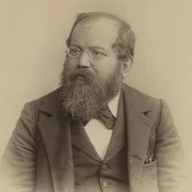
▶ Videos about Wilhelm Steinitz on ChessTube (3)
Beginnings
Born in Prague, in the Jewish quarter, the thirteenth child. The date is disputed: the birth register and his American passport application say 14 May 1836, while he himself once wrote that he was born on the 17th. He learned chess at twelve. From 1857 he studied mathematics at the Vienna Polytechnic.
Birth date and the two versions: article Wilhelm Steinitz, English Wikipedia, and Wikidata (Q102648), which gives 17 May.The Austrian Morphy
In 1861 he won the Vienna championship, and for the way he attacked his contemporaries called him “the Austrian Morphy”. The nickname says everything about how he played then, and about how much he would change.
The nickname and the 1861 championship: article Wilhelm Steinitz, English Wikipedia.The London years
At the London 1862 international tournament he finished sixth but won the brilliancy prize, and decided to stay in the city. In 1866 he beat Adolf Anderssen 8–6, and from that moment he was regarded as the strongest player in the world.
In match play he did not lose for thirty-two years, from 1862 to 1894.
London 1862, the Anderssen match and the thirty-two-year run: article Wilhelm Steinitz, English Wikipedia.1873: the new style
At Vienna 1873 he won the tournament playing in a way nobody had seen yet: pawn structure, control of space, a plan before the attack. Before him the king was attacked at once; he argued that the king should not be attacked until one already holds some other advantage. This is the beginning of positional chess.
Vienna 1873 and the change of style: article Wilhelm Steinitz, English Wikipedia.1886: the first world championship
In 1886 he faced Johannes Zukertort in a match played across New York, St. Louis and New Orleans, and won 12½ to 7½. It is the first match recognised as a world championship, and Steinitz the first champion.
Article Wilhelm Steinitz, English Wikipedia.The title defences
He defended the title three times: against Mikhail Chigorin in Havana in 1889 (10½–6½), against Isidor Gunsberg in New York in 1890-91 (10½–8½), and against Chigorin again in Havana in 1892 (12½–8).
On 23 November 1888 he became a United States citizen and changed his first name from Wilhelm to William. From 1885 he edited the International Chess Magazine, which he kept until 1891; for the New York 1889 tournament book he annotated all 432 games.
Matches, citizenship, magazine and tournament book: article Wilhelm Steinitz, English Wikipedia.The end
In 1894 he lost the title to Emanuel Lasker: five wins to ten, with four draws. He asked for a rematch and got it in 1896-97, in Moscow, where he lost more heavily: two to ten with five draws.
He died on 12 August 1900 at the Manhattan State Hospital on Ward’s Island, a pauper. He is buried in Brooklyn.
The two Lasker matches, his death and his financial state: article Wilhelm Steinitz, English Wikipedia.gm_maU0-ARorYdB: scacchiera giocabile, con la partita completa sotto.
gm__NyFoZpXCVli: scacchiera giocabile, con la partita completa sotto.
gm_XIn32hTIvAVh: scacchiera giocabile, con la partita completa sotto.
gm_iacQ82ckIJx8: scacchiera giocabile, con la partita completa sotto.
gm_dTNzbV59xy7K: scacchiera giocabile, con la partita completa sotto.
gm_HUqp5jIDvMJb: scacchiera giocabile, con la partita completa sotto.
gm_wtyu01o19Kvr: scacchiera giocabile, con la partita completa sotto.
How his contemporaries saw him
The nickname they gave him as a young man — “the Austrian Morphy” — is his contemporaries’ verdict on his attacking play, given when a comparison with Morphy was the highest compliment available.
Bobby Fischer, in 1964, called him “the so-called father of the modern school of chess” and wrote that “he understood more about the use of squares than did Morphy, and contributed a great deal more to chess theory”. He also noted that Steinitz, unlike Morphy, “was always looking for some completely original line” instead of following the books.
Fischer: The Ten Greatest Masters in History, Chessworld vol. 1 no. 1, January-February 1964, pp. 57-61.From the Vienna events to his last in London
Before he was world champion, Steinitz was a tournament player, and the placings describe a slow climb: sixth at London 1862 with 8 out of 13, at his first international appearance; second at Dundee 1867 with 7 out of 9; second at Baden-Baden 1870 with 12½ out of 18, behind Anderssen both times.
The breakthrough is Vienna 1873: equal first with Blackburne on 10 out of 11, then the play-off won 2-0. In our holdings that event is 25 encounters with 18 won, two lost and five drawn, that is 20½ out of 25: exactly the total the records give him.
Through his years as champion he played almost nothing but matches, and he came back to tournaments at the end, past fifty-eight. There the figures change sign: fifth at Hastings 1895 with 13 out of 21, behind Pillsbury, Chigorin, Lasker and Tarrasch; sixth at Nuremberg 1896 with 11 out of 18; fourth at Vienna 1898 with 23½ out of 36, aged sixty-two; and finally equal tenth at London 1899, the year before he died penniless. The first three our holdings recompute encounter by encounter, and they agree.
One figure sets him apart from everyone else on these pages. We credit him with 21 events of at least nine encounters, and not one did he finish without a defeat: among the champions with at least twenty events in our holdings he is the only one. In tournaments he lost games even when he won the tournament.
The placings and scores for London 1862, Dundee 1867, Baden-Baden 1870, Vienna 1873 with its play-off, Hastings 1895 with the names of those above him, Nuremberg 1896, Vienna 1898 and London 1899: Wilhelm Steinitz, English Wikipedia. The records for Vienna 1873, Hastings 1895, Nuremberg 1896 and Vienna 1898 are recounted on our own holdings and agree with those scores encounter by encounter. The count of events without a defeat is counted on our own holdings, with the criterion: events of at least nine encounters, excluding matches, simultaneous displays, blitz and rapid; the comparison with other champions is made across the pages published here, not across the whole history of chess. For Vienna 1882, London 1883 and London 1899 our holdings are one or two games short of the published totals, which is why we give no totals of our own for those three.The games
Our archive holds 583 games by Steinitz, from 1859 to 1899, against a hundred and forty different opponents. The positions below come from those games.
Games from PGN Mentor. The moves of a chess game are a fact, not a copyrighted work.Frequently asked questions
Where do Wilhelm Steinitz's positions come from?
From his real games. Every position is a moment in a game Wilhelm Steinitz actually played: above the board you can see both players, the tournament and the year. The best move is identified by Stockfish, analysing the position.
Why is the board covered?
So the solution is not given away to anyone scrolling the page. The first two ranks stay readable and the rest is veiled: the whole position appears when you open the puzzle.
Do I need an account to solve Wilhelm Steinitz's puzzles?
Yes. The puzzle is played on the training page, where the result counts towards that puzzle's leaderboard and moves the player's Elo rating. Without an account there is no rating to update.
Did Wilhelm Steinitz win all these positions?
No. Some come from games he lost, and in those the move to find belongs to his opponent. The box says so next to the board, before you open the puzzle.
What happens after solving or missing one of Wilhelm Steinitz's puzzles?
That puzzle's leaderboard appears, along with two ways on: leave, which brings you back to this page, or keep playing, which offers another position taken from Wilhelm Steinitz's games.
Can you see the whole game after the puzzle?
Yes. Once the puzzle is over, every move of that game appears, and they are clickable: tap one and the position goes onto the board while <b>Stockfish 18</b> analyses it on the spot, in your browser, showing the best lines. You can move back and forth through the whole game.
How many Wilhelm Steinitz positions are there?
At the moment 7. The number grows on its own: a program works through the archive of his games and adds new positions whenever it finds them.
Who wrote the biographical notes?
We wrote them ourselves. The at-a-glance data — dates, places, titles — comes from Wikidata and Wikipedia, under the licence stated below the panel.