Aaron Nimzowitsch
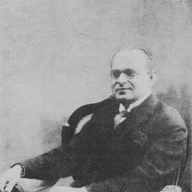
▶ Videos about Aaron Nimzowitsch on ChessTube (2)
Origins
Born in Riga, in the Russian Empire, on 7 November 1886. His name is written in many ways — Ārons Ņimcovičs in Latvian, Aron Isaevich Nimtsovich in Russian — and the sources themselves split between Aaron and Aron: Wikidata in Italian and German writes Aaron, the English Wikipedia article Aron. We use Aaron, which is also the form our games carry.
His father, Shaya Abramovich Nimzowitsch, a timber merchant, taught him to play. The oldest game we have of his is from 1905: he was eighteen.
Date, place, the spellings of the name and the father: Aron Nimzowitsch, English Wikipedia; dates confirmed on Wikidata (Q295114), which in Italian and German writes "Aaron". 1905 is the date of his oldest game in our archive.From Riga to Copenhagen
After the revolution he was stateless for five years. In 1922 he moved to Copenhagen, where he would live the rest of his life in a single rented room, and became a Danish citizen. He won the Nordic Championship twice, in 1924 and 1934.
Statelessness between 1917 and 1922, the move, the rented room and the two Nordic championships: Aron Nimzowitsch, English Wikipedia, which for the room cites The Oxford Companion to Chess, Hooper and Whyld, 1996, p. 272.The system
He is the most important name among the hypermoderns, and his three books are the reason: My System (1925–1927), The Blockade (1925) and Chess Praxis (1929).
The ideas he put in order are still used with the words he gave them: control of the centre with pieces rather than pawns, overprotection, the blockade, prophylaxis — the move that prevents instead of attacking — and development by fianchetto.
The three books with their years and the list of concepts: Aron Nimzowitsch, English Wikipedia.Against Tarrasch
His longest and bitterest dispute was with Siegbert Tarrasch, over what "proper" chess was. Nimzowitsch accused him of being dogmatic; Tarrasch, for his part, taught control of the centre with pawns and the single best move.
On the board, in our archive, he was the one winning the argument: eleven games, five wins, two losses and four draws — seven to four.
The nature and length of the conflict with Tarrasch: Aron Nimzowitsch, English Wikipedia. The record over the eleven games is counted on our archive. The page on Siegbert Tarrasch tells the same story from the other side.The best years
Between the late 1920s and the early 1930s he was third in the world, behind Alekhine and Capablanca, according to the retrospective Chessmetrics ratings. His first places: Copenhagen 1923, Marienbad 1925, Dresden 1926, Hanover 1926 and Carlsbad 1929. At San Remo 1930 he came second, behind Alekhine.
Three of those tournaments are crushing in our archive: at Dresden 1926 he scored eight wins, no losses and one draw in nine games; at Hanover the same year six wins and one draw out of seven; at Carlsbad 1929, over twenty-one games, ten wins, ten draws and a single loss.
The third place in the world 1927–1931 and the list of first places: Aron Nimzowitsch, English Wikipedia, citing Chessmetrics. The scores at Dresden, Hanover and Carlsbad are counted on the games in our archive, where that last tournament is recorded under its German name, Karlsbad.gm_yFqDbsfaffHN: scacchiera giocabile, con la partita completa sotto.
The immortal zugzwang game
His most famous game is against Fritz Sämisch, at Copenhagen in 1923, and it ends in a way one almost never sees. On the twenty-fifth move Nimzowitsch plays h6 — a pawn move, threatening nothing and taking nothing — and White resigns. Not because he has lost material: because every move he can make worsens his position. That is zugzwang, the obligation to move when moving hurts, and this game is its textbook example.
Three years later, at Dresden 1926, he produced another on the same theme against Paul Johner, and won it.
That these are the two zugzwang games: Aron Nimzowitsch, English Wikipedia. Both are in our archive and the moves confirm it: Sämisch–Nimzowitsch, Copenhagen 1923, fifty half-moves, with 25…h6 as the last and White's resignation; and Johner–Nimzowitsch, Dresden 1926, won by Black.Never the world title
He never played a world championship match. Against the two who stood above him the count is stark: with Capablanca, in our archive, ten games and no wins — four losses and six draws. With Alekhine nineteen games, two wins, eight losses and nine draws: the two wins came at Semmering in 1926 and New York in 1927, both with white.
Against the other greats of his time he held his own: Rudolf Spielmann twenty-eight games and eighteen to ten, Savielly Tartakower twenty-two and twelve to ten, Frank Marshall nineteen and ten to nine.
That he never played for the title: Aron Nimzowitsch, English Wikipedia, which for the overall records gives +0 −5 =6 against Capablanca and +3 −9 =9 against Alekhine. Our counts are slightly lower — ten games with Capablanca instead of eleven, nineteen with Alekhine instead of twenty-one — because our archive does not hold them all, and for the same reason it does not contain the win with black over Alekhine that the source places in their 1914 St Petersburg match: of the two we have, both are with white. The substance is unchanged: Capablanca never lost to him, and against Alekhine he was behind.How others describe him
He was a difficult man, and his colleagues told it with exasperated affection. Savielly Tartakower, who played him twenty-two times, said of him: "He pretends to be crazy in order to drive us all crazy."
Of his own, documented, there are two lines. The first: "The beauty of a move lies not in its appearance but in the thought behind it." The second has become a chess saying: "The threat is stronger than the execution."
On that second one a distinction is needed, because the line is genuine but the story it comes wrapped in probably is not. It is said that an opponent laid an unlit cigar on the table, and that he complained to the arbiters: "He is threatening to smoke, and as an old player you must know that the threat is stronger than the execution." Edward Winter, who checks chess quotations, considers it probably apocryphal. The line, though, does exist, and the source is the Danish magazine Skakbladet of 1933, where he wrote it about the effect of the queen on the board.
That his opponents' smoking annoyed him is documented.
Tartakower's line: Aron Nimzowitsch, English Wikipedia, citing Hans Kmoch. "The beauty of a move": Fred Reinfeld, Nimzovich: The Hypermodern, 1948, via Wikiquote. "The threat is stronger than the execution": Skakbladet 9, 1933, p. 137, via Wikiquote. That the cigar anecdote is probably apocryphal: Edward Winter, "A Nimzowitsch Story", chesshistory.com, cited by the same Wikipedia article.The last years, and the end
He played to the end. In 1930 he had his strongest year in our archive — thirty-seven games, twenty-six to eleven — and came second at San Remo. In 1934, his last full year, he played twenty-six: he won his second Nordic Championship and at Zurich finished on nine and six out of fifteen. The most recent games we have of his are from that tournament.
He had long suffered from heart trouble, but his death came unexpectedly: taken ill suddenly at the end of 1934, he lay bedridden for three months and died of pneumonia on 16 March 1935, aged forty-eight. He is buried in Bispebjerg Cemetery, in Copenhagen.
His ideas outlived him quickly: among those who studied them are Tartakower, Vidmar, Réti and Rubinstein — all opponents he had faced more than once.
The second Nordic championship of 1934, the illness, the three months bedridden, the pneumonia and the burial: Aron Nimzowitsch, English Wikipedia, which for the death cites The Oxford Companion to Chess, 1996, p. 273. The 1930 and 1934 records and the Zurich score are counted on the games in our archive. The list of those he influenced: the same Wikipedia article.gm_GmajtxYqvst6: scacchiera giocabile, con la partita completa sotto.
gm_lGIscoGzBiZS: scacchiera giocabile, con la partita completa sotto.
gm__BNwfc-0vZ0N: scacchiera giocabile, con la partita completa sotto.
gm_0pdi1Qwg9ibb: scacchiera giocabile, con la partita completa sotto.
gm_jwGxyxCt1qwc: scacchiera giocabile, con la partita completa sotto.
gm_GPc0PIuj_VP3: scacchiera giocabile, con la partita completa sotto.
gm_UmXs7eu3au7s: scacchiera giocabile, con la partita completa sotto.
Carlsbad, four times in twenty-two years
No place recurs in his career like Carlsbad, the Bohemian spa town that hosted the longest tournaments in Europe. Nimzowitsch went four times, and in our holdings those four editions come to 83 games — more than he played in any other city.
In 1907, aged twenty, he finished with eight wins, three losses and nine draws out of twenty. In 1911, over twenty-five games, eleven, five and nine. In 1923, after his stateless years, eight, five and four out of seventeen. In 1929 came first place, with 15 points out of 21: the detail of those twenty-one games is given further up. Twenty-two years had passed between the first visit and the last.
The other engagement that comes out longest of all for us is Ostend 1907, the masters' tournament: twenty-eight games, fourteen won, four lost and ten drawn. It was his first great international round-robin, and he played it at twenty.
Then there are the four strongest fields he ever met — San Sebastián 1912, Baden-Baden 1925, New York 1927 and Bled 1931 — and in none of the four does his name appear among the first places listed further up. At Bled, his last great test, he played twenty-six games and won eight, losing six. Across everything we credit to him, the round-robins of nine games or more number 30: four of them ended with the losses column empty.
Every figure in this section is counted on our own holdings: the four Carlsbad editions with their records and the total of 83 games, the twenty-eight of Ostend 1907, the twenty-six of Bled 1931 and the count of 4 events out of 30 without a defeat, with the criterion: events of at least nine games, excluding matches, simultaneous displays, blitz and rapid. The first place at Carlsbad 1929 and the list of his first places come from the Aron Nimzowitsch article on English Wikipedia, already cited further up; for the other tournaments in this section that article gives no placings, which is why we give none here — we say only that they are not among his first places.The games
Our archive holds 512 games of Nimzowitsch's, from 1905 to 1934, against 166 different opponents. The most frequent are Rudolf Spielmann (28 games), Savielly Tartakower (22), Akiba Rubinstein (22), Alekhine (19) and Frank Marshall (19). The positions below come from these games.
Games from PGN Mentor. Games, years, opponents and records are counted on our own archive: the 166 opponents are an exact figure, because here no player appears under two different spellings. The moves of a game are a fact, not a protected work.Frequently asked questions
Where do Aaron Nimzowitsch's positions come from?
From his real games. Every position is a moment in a game Aaron Nimzowitsch actually played: above the board you can see both players, the tournament and the year. The best move is identified by Stockfish, analysing the position.
Why is the board covered?
So the solution is not given away to anyone scrolling the page. The first two ranks stay readable and the rest is veiled: the whole position appears when you open the puzzle.
Do I need an account to solve Aaron Nimzowitsch's puzzles?
Yes. The puzzle is played on the training page, where the result counts towards that puzzle's leaderboard and moves the player's Elo rating. Without an account there is no rating to update.
Did Aaron Nimzowitsch win all these positions?
No. Some come from games he lost, and in those the move to find belongs to his opponent. The box says so next to the board, before you open the puzzle.
What happens after solving or missing one of Aaron Nimzowitsch's puzzles?
That puzzle's leaderboard appears, along with two ways on: leave, which brings you back to this page, or keep playing, which offers another position taken from Aaron Nimzowitsch's games.
Can you see the whole game after the puzzle?
Yes. Once the puzzle is over, every move of that game appears, and they are clickable: tap one and the position goes onto the board while <b>Stockfish 18</b> analyses it on the spot, in your browser, showing the best lines. You can move back and forth through the whole game.
How many Aaron Nimzowitsch positions are there?
At the moment 8. The number grows on its own: a program works through the archive of his games and adds new positions whenever it finds them.
Who wrote the biographical notes?
We wrote them ourselves. The at-a-glance data — dates, places, titles — comes from Wikidata and Wikipedia, under the licence stated below the panel.