Richard Teichmann
Beginnings
Born on 24 December 1868 in Lehnitzsch, near Altenburg, in the Duchy of Saxe-Altenburg. He studied philology at the universities of Jena and Berlin.
It was in Berlin that he first got noticed: in 1890/91 he won a tournament of the Berliner Schachgesellschaft, the city’s chess society.
Birth: Richard Teichmann, English Wikipedia. His studies and the Berlin tournament: Richard Teichmann, German Wikipedia, which dates his birth to 23 December rather than the 24th.One eye
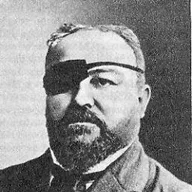
He lost his right eye when young. He could not bear a glass eye, so he always played with an eye patch. Eye trouble followed him throughout his career: in 1899, at the London tournament, he had to withdraw after four rounds. It weighs heavily in a trade where you spend six hours a day staring at sixty-four squares.
The eye patch and the glass eye: Richard Teichmann, German Wikipedia. The chronic trouble and the London 1899 withdrawal: Richard Teichmann, English Wikipedia.The London years
From 1892 to 1908 he lived in London. In his first year he shared second place in the Simpson’s Divan tournament. In 1894, in Leipzig, he was third behind Siegbert Tarrasch and Paul Lipke.
Then came the English wins: in 1900 he won the London tournament ahead of Blackburne, Gunsberg and Mason, and in 1901 the five-masters tournament at Simpson’s Divan. In 1904 he was second in the City of London tournament, behind William Napier.
The English years and the results from 1892 to 1904: Richard Teichmann, German Wikipedia.“Richard the Fifth”
The nickname came from his colleagues, and it was not kind: Richard the Fifth, because in tournaments he came fifth with a regularity that had become a joke. He drew a lot, and those fifth places came partly from there. It is the portrait of a very strong player who was never quite strong enough: he belonged in the masters’ room by right, and almost never on the top step.
The nickname: Richard Teichmann, English Wikipedia; the many draws as a cause: Richard Teichmann, German Wikipedia.Carlsbad 1911
Then, once, he came first. At Carlsbad in 1911 he won the tournament ahead of everyone, beating Akiba Rubinstein and Carl Schlechter — two of the strongest players in the world — with the same line of the Ruy Lopez. At forty-two, after twenty years of fifth places.
The next year, at Breslau, he was third behind Oldřich Duras and Rubinstein. It was the high point of his career: historical reconstructions of the Elo rating give him 2744 in January 1912, and put him for a while fifth in the world rankings. Fifth, of course.
Carlsbad and the two games with the same line: Richard Teichmann, English Wikipedia. Breslau 1912, the historical rating and the world ranking: Richard Teichmann, German Wikipedia.The opponents
His personal scores show where his limit lay. Against Emanuel Lasker: four games, four losses. Against José Raúl Capablanca: two losses and a draw. Against Alexander Alekhine, though, he held his own — three wins, four losses, four draws — and in 1921, in Berlin, he drew a match with him.
With Carl Schlechter the score was 4 wins and 2 losses in twenty-seven games: twenty were drawn, which says something about both of them. In matches he beat Frank Marshall, Jacques Mieses and Rudolf Spielmann.
And Capablanca, who never lost to him, considered him “one of the finest players in the world”.
Scores against Lasker, Capablanca, Alekhine and Schlechter, and Capablanca’s verdict: Richard Teichmann, English Wikipedia. The matches he won: Richard Teichmann, German Wikipedia.gm_n8XdZ8fqiH2g: scacchiera giocabile, con la partita completa sotto.
gm_b0lz0XA8PJEF: scacchiera giocabile, con la partita completa sotto.
gm_h2jniCQTTSSk: scacchiera giocabile, con la partita completa sotto.
gm_F8qAYKYP-dIR: scacchiera giocabile, con la partita completa sotto.
gm_jf799GwTZ0GM: scacchiera giocabile, con la partita completa sotto.
gm_XMzmsEC4kvbn: scacchiera giocabile, con la partita completa sotto.
gm_1jWPFarryqa4: scacchiera giocabile, con la partita completa sotto.
The line he never wrote
Today Teichmann is known above all for five words: “Chess is 99 percent tactics”. It is one of the most quoted lines in the game, and the story of how it got there is worth more than the line itself.
It appears in none of his publications. It was reported by the Swiss master Erwin Voellmy, who heard him say it in private conversation — and who, when he published it, noted that Teichmann slightly exaggerated
. Reuben Fine was already quoting it in 1945.
So: a true saying, really said, by a man who never wrote it and who, according to the man who heard it, was exaggerating. On our home page it is given like that, with its provenance — and that is why his face is there.
Attribution, absence from his writings and Voellmy’s testimony: Richard Teichmann, English Wikipedia; see also Edward Winter, Chess Notes.The end
Besides playing, he composed: a few of his problems and studies survive.
He died in Berlin on 15 June 1925, aged fifty-six, after a long kidney illness.
Problems and studies, the illness: Richard Teichmann, German Wikipedia, which dates his death to 12 June. The date of the 15th is from Richard Teichmann, English Wikipedia.The draws of "Richard the Fifth"
The nickname states the placing; the figures explain it. Our holdings contain 536 of his games, and 218 end level: 40.7 per cent, one of the highest shares on these pages. A player who halves two games in five finishes fifth rather often.
The extreme case is San Sebastián 1912: nineteen games, none won, three lost and sixteen drawn. A whole tournament closed without a win, and almost without a defeat.
In the summer of 1907, at Ostend, he played his longest commitment: twenty-eight encounters, with fourteen victories, six defeats and eight halved. Then Monte Carlo twice — 1902, 15 out of 23, and 1903, 16½ out of 26 — and Ostend 1905, 14 out of 26. The two events of 1908, at Vienna and at Prague, he closed with an identical record: six wins, one loss and twelve draws out of nineteen, in both.
Of the 26 engagements of at least nine games we credit him with, only one ended without a defeat: the Berlin jubilee tournament of 1907. The year the nickname stopped applying, Carlsbad 1911, comes to eighteen points out of twenty-five for us, with just two defeats in twenty-five games: what separates it from his other events is not the draws, which still number ten, but the losses that are not there.
Every figure in this section is counted on our own holdings: the 536 games and the draw percentage, San Sebastián 1912, Ostend 1907, Monte Carlo 1902 and 1903, Ostend 1905, Vienna and Prague 1908, Carlsbad 1911 and the count of a single engagement without a defeat out of 26, with the criterion: engagements of at least nine games, excluding matches, simultaneous displays, blitz and rapid. The comparison of draw percentages is made across the pages published here. The nickname and the Carlsbad 1911 victory are described further up, with their sources.The games
The archive holds 536 of his games, from 1893 to 1924. The positions appear in the sections for the years they belong to, as the engine analyses them.
Frequently asked questions
Where do Richard Teichmann's positions come from?
From his real games. Every position is a moment in a game Richard Teichmann actually played: above the board you can see both players, the tournament and the year. The best move is identified by Stockfish, analysing the position.
Why is the board covered?
So the solution is not given away to anyone scrolling the page. The first two ranks stay readable and the rest is veiled: the whole position appears when you open the puzzle.
Do I need an account to solve Richard Teichmann's puzzles?
Yes. The puzzle is played on the training page, where the result counts towards that puzzle's leaderboard and moves the player's Elo rating. Without an account there is no rating to update.
Did Richard Teichmann win all these positions?
No. Some come from games he lost, and in those the move to find belongs to his opponent. The box says so next to the board, before you open the puzzle.
What happens after solving or missing one of Richard Teichmann's puzzles?
That puzzle's leaderboard appears, along with two ways on: leave, which brings you back to this page, or keep playing, which offers another position taken from Richard Teichmann's games.
Can you see the whole game after the puzzle?
Yes. Once the puzzle is over, every move of that game appears, and they are clickable: tap one and the position goes onto the board while <b>Stockfish 18</b> analyses it on the spot, in your browser, showing the best lines. You can move back and forth through the whole game.
How many Richard Teichmann positions are there?
At the moment 7. The number grows on its own: a program works through the archive of his games and adds new positions whenever it finds them.
Who wrote the biographical notes?
We wrote them ourselves. The at-a-glance data — dates, places, titles — comes from Wikidata and Wikipedia, under the licence stated below the panel.