Savielly Tartakower
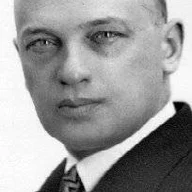
▶ Videos about Savielly Tartakower on ChessTube (1)
Beginnings
Born in Rostov-on-Don on 21 February 1887 — the 9th by the Julian calendar, then in use in Russia — to Austrian parents of Jewish origin. His father was a well-off businessman who owned a textile factory; according to other sources, a chain of shops.
He studied law and graduated between Geneva and Vienna. It was in Vienna, during his university years, that he took to chess: he went to the chess gatherings in the cafés, where the game was played in those days.
Birth, family, studies and the Vienna cafés: Savielly Tartakower, English Wikipedia.Vienna and the war
In 1906 he won a tournament in Nuremberg. Three years later, in Vienna, he finished second behind Richard Réti.
In 1911 his parents were killed during a break-in at their home in Rostov. He was twenty-four.
In the First World War he was called up into the Austro-Hungarian army. He served as a staff officer, and went to the Russian front with Vienna’s infantry regiment.
Nuremberg and Vienna, his parents’ death and his military service: Savielly Tartakower, English Wikipedia.The Hastings years
Between the wars he was one of the most recognisable players in Europe. He won Hastings in 1927 and 1928, Liège in 1930 two points clear of Mir Sultan Khan, and shared first place in London with Aron Nimzowitsch. He was also the theorist of a way of playing then called hypermodern: his Die hypermoderne Schachpartie came out in 1924.
Tournament results: Savielly Tartakower, English Wikipedia.gm_VUgM4TU_P2sf: scacchiera giocabile, con la partita completa sotto.
The Polish championships
When Poland regained its independence in 1918 he took Polish citizenship, even though he did not speak Polish. For Poland he won the national championship twice: in Warsaw in 1935 and in Jurata in 1937.
He played six Olympiads for Poland. At Hamburg in 1930, on second board, he was in the team that won gold; then came silver in 1931 and 1939 and bronze in 1935 and 1937. Individually, gold in 1931 and bronze in 1933 and 1935.
Polish citizenship, national championships and Olympiads: Savielly Tartakower, English Wikipedia.Lieutenant Cartier
When the Second World War broke out he was in Buenos Aires, for the 1939 Olympiad. He returned to Europe and reached France shortly before its collapse in 1940.
There he joined Charles de Gaulle’s forces, under the nom de guerre “Lieutenant Cartier”. He was over fifty. It is the part of his life you least expect from a man remembered mainly for his aphorisms.
The 1939 Olympiad, the return to France and the nom de guerre: Savielly Tartakower, English Wikipedia. In its body the article says he joined de Gaulle’s forces; in its introduction it speaks of the French Resistance instead. This page follows the body.The last season
After the war, with Poland under Soviet control, he took French citizenship. In 1948 he played the Saltsjöbaden Interzonal, but did not qualify for the Candidates.
In 1950, when FIDE awarded the Grandmaster title for the first time, he was among the first to receive it: he was sixty-three. The same year he played his last Olympiad, this time for France. In 1953, at sixty-six, he won the French championship.
He died in Paris on 4 February 1956, seventeen days before his sixty-ninth birthday.
French citizenship, the 1948 Interzonal, the 1950 title, the Olympiad for France, the 1953 championship and his death: Savielly Tartakower, English Wikipedia.gm_rJ1ZNFPyJbFJ: scacchiera giocabile, con la partita completa sotto.
gm_iynggwVQ3I2N: scacchiera giocabile, con la partita completa sotto.
gm_2HefQrkBw5yn: scacchiera giocabile, con la partita completa sotto.
gm_Ubt6eDalnfiU: scacchiera giocabile, con la partita completa sotto.
gm_j-5Q1m2xB1Nc: scacchiera giocabile, con la partita completa sotto.
gm_5WwXmgmnn3of: scacchiera giocabile, con la partita completa sotto.
The openings
The Tartakower Defence of the Queen’s Gambit Declined bears his name, and there are Tartakower variations of the Dutch and of the Caro–Kann. The article also credits him with originating the Catalan Opening, at Barcelona in 1929.
And then there is 1.b4, known as the Orangutan. The story goes that he named it himself, during the New York tournament of 1924, after admiring a great ape on a visit to the zoo. Caution is in order: the article itself calls him its “alleged” inventor.
The openings named after him, the Catalan and the Orangutan story: Savielly Tartakower, English Wikipedia.The sayings
He is remembered at least as much for the sayings attributed to him as for his games, so much so that they have a name: “Tartakowerisms”. Dozens circulate, most without a verifiable source. Two that hold up to checking are among the quotations on our home page. I am not adding more here: collections of chess aphorisms are the least reliable place to look for who said what.
A wit like his invited nicknames too. A colleague called him “Tarta-caviar”.
The name “Tartakowerisms” and the nickname: Savielly Tartakower, English Wikipedia.The books
Die hypermoderne Schachpartie (1924), Bréviaire des échecs, 500 Master Games of Chess and 100 Master Games of Modern Chess — those two with Julius du Mont — and My Best Games of Chess 1905–1954.
List of titles from Savielly Tartakower, English Wikipedia. This page gives the titles of the books, not their contents.Seven Olympiads, two flags
He played seven Olympiads, and not all for the same country: six with Poland between 1930 and 1939, the last with France at Dubrovnik in 1950, aged sixty-three.
The medals are many. Individual: gold at Prague 1931, bronze at Folkestone 1933 and at Warsaw 1935. With the team: gold at Hamburg 1930, silver at Prague 1931 and at Buenos Aires 1939, bronze at Warsaw 1935 and at Stockholm 1937. At Warsaw, on first board, he finished losing nothing: six wins and eleven halved.
In our holdings those seven editions are 72 games, with 34 won, 14 lost and 24 drawn. Two of them we recompute exactly as they stand elsewhere: Buenos Aires 1939, seven wins, three losses and seven halved, and Dubrovnik 1950, five, five and five. Of the other five editions we possess only a fraction of the encounters: that is why our total stays below what he actually played.
There is then a figure that describes him better than any adjective: out of 1289 games in our archive, 572 end level — 44.4 per cent, the highest share on these pages. Of the 77 commitments of at least nine games we credit him with, 10 ended without a defeat, and the longest is Ljubljana 1938: fifteen games, four wins and eleven halved.
The seven Olympiads with the countries, boards, scores and all the individual and team medals, and the Liège 1930 win over Sultan Khan by two points: Savielly Tartakower, English Wikipedia. The 72 Olympiad games with their record, the exact agreements for Buenos Aires 1939 and Dubrovnik 1950, the 1289 games with the draw percentage and the count of 10 commitments out of 77 without a defeat are counted on our own holdings, with the criterion: commitments of at least nine games, excluding matches, simultaneous displays, blitz and rapid. The comparison of draw percentages is made across the pages published here.The games
The archive holds 1,289 of his games, from 1906 to 1954. The positions appear in the sections for the years they belong to, as the engine analyses them.
Frequently asked questions
Where do Savielly Tartakower's positions come from?
From his real games. Every position is a moment in a game Savielly Tartakower actually played: above the board you can see both players, the tournament and the year. The best move is identified by Stockfish, analysing the position.
Why is the board covered?
So the solution is not given away to anyone scrolling the page. The first two ranks stay readable and the rest is veiled: the whole position appears when you open the puzzle.
Do I need an account to solve Savielly Tartakower's puzzles?
Yes. The puzzle is played on the training page, where the result counts towards that puzzle's leaderboard and moves the player's Elo rating. Without an account there is no rating to update.
Did Savielly Tartakower win all these positions?
No. Some come from games he lost, and in those the move to find belongs to his opponent. The box says so next to the board, before you open the puzzle.
What happens after solving or missing one of Savielly Tartakower's puzzles?
That puzzle's leaderboard appears, along with two ways on: leave, which brings you back to this page, or keep playing, which offers another position taken from Savielly Tartakower's games.
Can you see the whole game after the puzzle?
Yes. Once the puzzle is over, every move of that game appears, and they are clickable: tap one and the position goes onto the board while <b>Stockfish 18</b> analyses it on the spot, in your browser, showing the best lines. You can move back and forth through the whole game.
How many Savielly Tartakower positions are there?
At the moment 7. The number grows on its own: a program works through the archive of his games and adds new positions whenever it finds them.
Who wrote the biographical notes?
We wrote them ourselves. The at-a-glance data — dates, places, titles — comes from Wikidata and Wikipedia, under the licence stated below the panel.